US Navy Submarine Force Pacific Fleet Patch
- SKU:
- 11614
- MPN:
- 11614
- Width:
- 4.50 (in)
- Height:
- 2.50 (in)
- Depth:
- 0.08 (in)
- Backing:
- Iron On
- Edging:
- Merrowed Edge


Description
The dolphins on a submariner's chest are not dolphins at all, they are dolphinfish, mahi-mahi, resting their heads on the bow planes of an O-class submarine. Capt. Ernest J. King proposed the device in the summer of 1923 while commanding Submarine Division Three, and it was approved on March 24, 1924. Officers wear gold and enlisted men wear silver, and a sailor earns them only by qualifying in submarines. This patch carries them for the Submarine Force, U.S. Pacific Fleet, SUBPAC. The Pacific boats have been at Pearl Harbor since four K-class submarines operated from Kuahua Island beginning in 1915.
At the start of World War II, 22 of the 51 American submarines in the Pacific were homeported at Pearl Harbor. Pacific Fleet submarines made 488 war patrols and sank 54 percent of enemy shipping, 5 million tons, at a cost of 52 submarines, 374 officers and 3,131 enlisted men. USS Sargo brought nuclear power to the Pacific in 1958, Los Angeles-class attack boats joined the Permit and Sturgeon boats in 1978, and USS Ohio arrived in August 1982, with the Trident boats homeported at Bangor, Washington. On January 19, 1991, USS Louisville became the first submarine to fire a Tomahawk at an enemy target. In March 2003 USS Cheyenne was the first U.S. warship to fire Tomahawks into Baghdad at the start of Operation Iraqi Freedom.
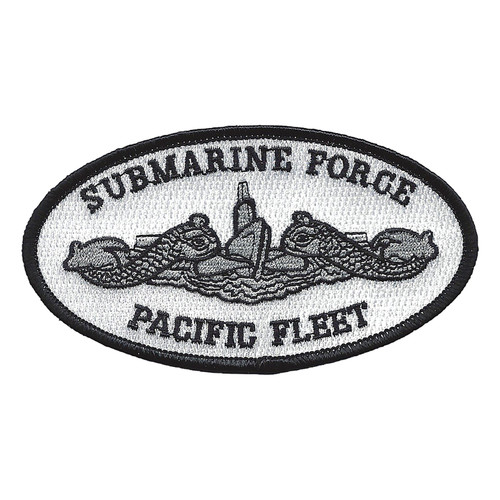
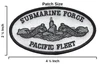
The patch is an oval, 4.5 inches wide and 2.5 inches tall, with a black merrowed edge. SUBMARINE FORCE arches across the top and PACIFIC FLEET runs along the bottom in bold black letters. Across the white center sit the dolphins in silver gray and black, two dolphinfish facing a submarine seen bow on, her sail rising between them and the sea curling under the hull. Silver is the color of the enlisted dolphins, the ones most submariners earned in qualification. It has an iron-on backing and can be sewn on for good.
Submarine duty asks a sailor to learn the whole boat, every system and every compartment, before he wears dolphins. The Pacific force carried the war to Japan when there was little else that could, and the 52 boats still on eternal patrol are remembered at every submarine ball. Through the Cold War its crews went out for months at a time and could say almost nothing about where they had been. That silence is part of the job, and so are the friendships made in a boat that small. Qualified men know each other by the dolphins.
Put it in a shadow box with your dolphins and your boat's patch, or on the vest you wear to a submarine veterans' meeting. It also makes a good gift for a father or grandfather who qualified in the Pacific. Black and white, with the dolphins at the center.
Related Products