
US Army Air Forces Patch Large
- SKU:
- 6055
- MPN:
- 6055
- Width:
- 4.00 (in)
- Height:
- 4.00 (in)
- Depth:
- 0.08 (in)
- Backing:
- Iron On
- Edging:
- Merrowed Edge
- Era:
- World War II

Description
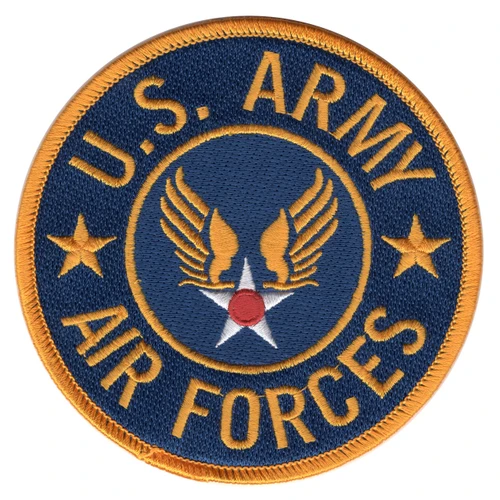
The red dot at the center of the star stayed on this AAF shoulder patch, approved on February 23, 1942, even after the Army painted that red center off its aircraft in May 1942 so it could not be mistaken for the Japanese rising sun. The white star with the red disc had been on American military aircraft since 1917. On this patch it sits under a pair of gold wings, the winged star every AAF man knew. The U.S. Army Air Forces was created on June 20, 1941, to succeed the Army Air Corps, and six years later it became the independent U.S. Air Force.
General Henry H. "Hap" Arnold led the AAF from 1941 to 1946, and General Carl Spaatz took it to independence in 1947. By March 1944 the Army Air Forces had about 2.4 million people, and by July 1944 nearly 80,000 aircraft. Sixteen numbered air forces fought the war, among them the Eighth over Europe, the Fifteenth out of Italy and the Twentieth flying against Japan, and the B-17 Flying Fortress, B-24 Liberator and B-29 Superfortress carried the bombing campaigns, while the P-38 Lightning, P-47 Thunderbolt and P-51 Mustang flew escort and ground attack. The AAF ended on September 18, 1947, when the National Security Act made the U.S. Air Force its own service.
This is the large version, a 4 inch round with a gold merrowed edge rolled all the way around. U.S. ARMY arcs across the top and AIR FORCES across the bottom in gold letters on a deep blue field, with a gold star on each side. An inner gold ring frames the center, where two gold wings rise from a white star with a red disc in the middle. Blue and gold were the AAF's colors, and the patch keeps to them. At this size it reads across a room in a shadow box or on the back of a jacket.
More than two million Americans wore the AAF patch, from mechanics on the flight line to the crews who flew daylight missions over Germany and the long overwater runs to Japan. Many of them never saw combat, and the air war still could not have been fought without them. The losses in the bomber groups were heavy, and the men who came home did not talk much about them. The AAF lasted only six years, but it built the air force the country still flies. This patch is how those men told the world where they belonged.
This patch has an iron-on backing and can also be sewn on, which holds up better on a jacket that will be worn. Frame it in a shadow box with a grandfather's wings, ribbons and a photo from his bomb group, or sew it on a leather flight jacket. It makes a good gift for anyone whose family served in the Army Air Forces. Blue, gold and that red dot say AAF.
Related Products


