
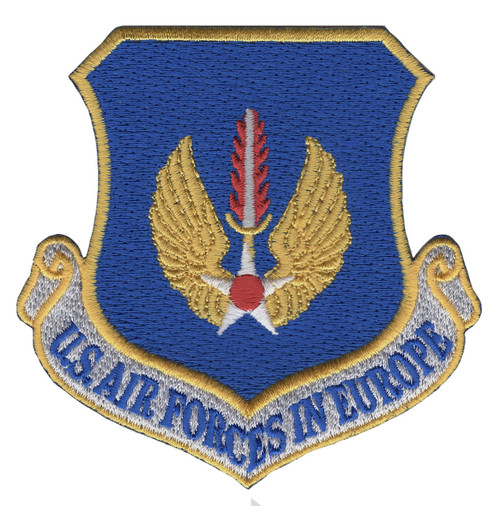
U.S. Air Forces in Europe USAFE Command Patch
- SKU:
- 9673
- MPN:
- 9673
- Width:
- 3.00 (in)
- Height:
- 3.00 (in)
- Depth:
- 0.08 (in)
- Backing:
- Iron On
- Edging:
- Cut Edge
- Era:
- Cold War


Description
USAFE started life as the Eighth Air Force, became U.S. Strategic Air Forces in Europe in February 1944, and took the name United States Air Forces in Europe on 7 August 1945. It was made a major command in March 1946, and for the next half century it was the Air Force's front line in Europe. Headquarters sat at Wiesbaden until 1953, at Lindsey Air Station until March 1973, and at Ramstein Air Base ever since. In 2012 the command merged with U.S. Air Forces Africa and took its current two-part name. An airman who wore this patch can usually tell you which base, which wing and which winter.
The first big job came in June 1948, when the Soviets closed the roads into Berlin and USAFE started flying the city its food and coal. The Berlin Airlift ran 464 days, past the end of the blockade on 12 May 1949 and on to the end of September. In the 1961 Berlin Crisis, RF-84F Thunderflash reconnaissance jets, F-86 Sabres, F-100D Super Sabres and F-104 Starfighters came over in Operations Tack Hammer and Stair Step. The F-4 Phantom II took over the fighter wings in 1968, the 36th Tactical Fighter Wing at Bitburg brought the first F-15 Eagles to Germany in April 1977, and by 1986 F-15s and F-16 Fighting Falcons had replaced every USAFE Phantom wing. For Desert Shield and Desert Storm the command sent more than 180 aircraft and 5,400 people, then flew A-10 Thunderbolt IIs in Provide Comfort, patrolled Bosnia in Deny Flight and flew the 78 days of Allied Force over Kosovo in 1999.
The patch is a blue shield with a gold border, and a silver scroll wraps its base reading U.S. AIR FORCES IN EUROPE in blue letters. At the center a pair of gold wings spreads out on either side of an upright white sword, its blade edged in red. The grip of the sword runs down into a white five-pointed star with a red center. Blue and gold are the Air Force's colors. It is 3 by 3 inches with a cut edge and iron-on backing, sized for a flight jacket or a vest.
For a lot of airmen, USAFE was the first tour overseas and the one they still talk about. Duty meant alert pads and NATO exercises, German winters and English fog, and a mission that did not stop for weekends. The command flew the Berlin Airlift, stood watch through the whole Cold War, and then went to work over the Gulf and the Balkans. Ramstein, Spangdahlem, Bitburg, Hahn, Incirlik and Mildenhall are names that bring back whole tours.
It belongs in a shadow box with your wing patches and a squadron photo from Germany, England or Turkey, or on the vest you wear to reunions. It also makes a good gift for a son or daughter who grew up on a base overseas. Wherever you served in Europe, this is the command that sent you there.
Related Products


