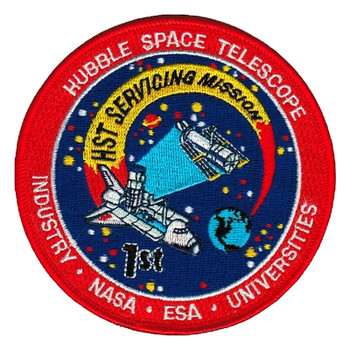
STS-103 Discovery Hubble Servicing Mission 3A Patch

- SKU:
- 10571
- MPN:
- 10571
- Width:
- 4.00 (in)
- Height:
- 4.00 (in)
- Depth:
- 0.08 (in)
- Backing:
- Sew On
- Edging:
- Merrowed Edge


Description
Hubble was already in safe mode when Discovery launched, shut down on November 13, 1999, after the fourth of its six gyroscopes failed. The telescope needs at least three working gyros to point precisely, and it had been running short for months. NASA had already split the third servicing mission in two, moving the urgent repair work up from June 2000 to STS-103, Servicing Mission 3A. Discovery left Pad 39B on December 19, 1999, after nine scrubs and delays. The crew released a working Hubble from the payload bay on Christmas Day, the third time a U.S. crew spent Christmas in space.
Curtis L. Brown commanded, Scott J. Kelly was pilot, and Steven L. Smith was payload commander, flying with C. Michael Foale, John M. Grunsfeld and ESA astronauts Claude Nicollier and Jean-Francois Clervoy. Clervoy grappled the telescope with the robot arm. Smith and Grunsfeld spent about eight hours on the first spacewalk replacing three Rate Sensor Units, each holding two gyroscopes, and fitting voltage and temperature kits to Hubble's six batteries. Foale and Nicollier installed a new computer about 20 times faster than the old one and a 550-pound fine guidance sensor. On the third spacewalk Smith and Grunsfeld replaced a transmitter that had failed in 1998 and swapped a mechanical recorder for a solid-state one. The flight was cut from ten days to eight to have systems secured before the Year 2000 rollover, and Discovery landed at Kennedy on December 27.
This is a round patch, 4 inches across, with a red merrowed border around a dark navy field. Hubble sits at the top with its yellow solar arrays spread, and Discovery comes in from the lower left to capture it. The thin green horizontal and vertical lines centered on the telescope stand for the ability to reach and hold a desired attitude in space, the exact job the new gyroscopes were going up to do. Earth's blue and green limb curves across the upper right, and a silver starburst of sunlight fills the lower right. The crew's names run around the edge in white: Brown, Kelly, Clervoy, Grunsfeld, Smith, Foale and Nicollier. Nicollier led the design, and he picked colors to show how Hubble looks in sunlight against black space and the night side of Earth.
STS-103 was a repair call with the telescope already down. Hubble had gone quiet in mid-November, and seven people had about a week in orbit to bring it back before the year ran out. Three spacewalks of eight hours or more put in new gyros, a new computer, a new guidance sensor and a new recorder. The rest of the planned upgrades waited for a second mission in 2002. When Discovery came home on December 27, Hubble was back in orbit with its new gyros.
It fits a shadow box next to other Hubble servicing mission patches, or framed with a print of the telescope over Earth. It is also a good gift for an astronomy fan, or for someone who remembers watching the Christmas 1999 spacewalks. Seven names, one telescope, and a repair finished before the year 2000.
Related Products