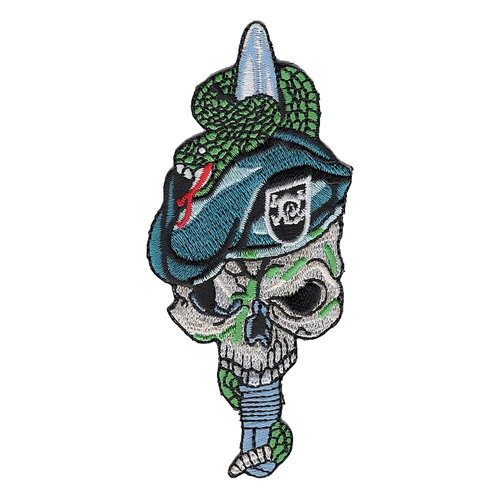
Special Forces Skull With Viper And Green Beret Patch
- SKU:
- 5576
- MPN:
- 5576
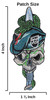
- Width:
- 1.75 (in)
- Height:
- 4.00 (in)
- Depth:
- 0.08 (in)
- Backing:
- Iron On
- Edging:
- Cut Edge


Description
The upturned dagger running through this skull reads as a nod to the blade at the center of the Special Forces arrowhead, the Fairbairn-Sykes knife of the British Commandos and the OSS. Wrap a viper around it, crown the skull with a green beret, and you have a piece of team-room morale art. There is no unit number and no lettering on it. The beret says Special Forces without a word. It is the kind of design that ends up on a team's challenge coins, on a sticker on a ruck, and on the wall of a team room.
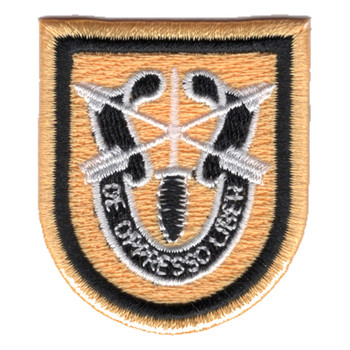
Special Forces began in June 1952, when the 10th Special Forces Group stood up at Fort Bragg, North Carolina, under Col. Aaron Bank, a veteran of the OSS Jedburgh teams. On 12 October 1961, President Kennedy visited Fort Bragg and met Brig. Gen. William P. Yarborough, commander of the Special Warfare Center, who wore the beret for the occasion. Kennedy backed the green beret for Special Forces, and in an April 1962 White House memorandum called it a symbol of excellence and a badge of courage. The arrowhead shoulder patch had been approved in 1955, the Airborne tab added in 1958 and the Special Forces tab in 1983. The motto, De Oppresso Liber, means To Free the Oppressed.
The patch is 1.75 inches wide and 4 inches tall, cut close to the outline of the design, with an iron-on backing. A pale blue blade points up out of the top, and the wrapped grip and pommel finish at the bottom. A green scaled viper coils around the blade and drapes over a teal green beret, its head hanging down at the left with fangs bared and a red tongue out. On the beret sits a black and white flash, and under it a white skull with a second length of snake threaded through it. The dagger is the element that ties it to the Special Forces patch; the skull and snake are morale-patch tradition, there to look hard.
Special Forces soldiers spend their careers in small teams, often far from any flagpole, working by, with and through partner forces. The beret is worn by soldiers who passed selection and earned the tab, and the community treats it that way. From the A-camps of Vietnam to the mountains of Afghanistan, the twelve-man detachment has been the basic unit of the work. That history is why a patch like this lands with people who know the regiment. It does not explain itself to outsiders, and it does not need to.
Put it on a range bag, a ruck or the sleeve of a field jacket, or set it in a shadow box with a beret flash and a team photo. It is also a good gift for a Special Forces veteran or for someone heading to selection. The iron-on backing works for display, and a few stitches make it permanent. Skull, snake and dagger, at a size that fits almost anywhere.
Related Products