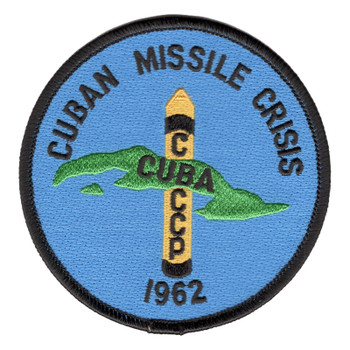
Small Cuban Missile Crisis Patch

- SKU:
- 13345
- MPN:
- 13345
- Width:
- 2.50 (in)
- Height:
- 2.50 (in)
- Depth:
- 0.08 (in)
- Backing:
- Iron On
- Edging:
- Merrowed Edge
- Era:
- Cold War


Description
The letters stacked down the missile read CCCP, which is USSR in Cyrillic, and the missile stands straight through the middle of Cuba. That one picture is the whole crisis of October 1962: Soviet ballistic missiles on an island about 90 miles from Florida. The design keeps it that plain. A light blue sea, a green island, a tan missile and the year. Anyone who stood watch, flew or loaded out that month knows exactly what it means without another word.
The crisis opened on Sunday, October 14, 1962, when Maj. Richard S. Heyser flew a U-2 over western Cuba at about 72,500 feet. Photo interpreters at the National Photographic Intelligence Center found SS-4 medium-range ballistic missile equipment on his film. On October 22, President Kennedy told the nation what the photographs showed and announced a naval quarantine of Cuba. Navy light photographic squadron VFP-62, the Fighting Photos, under Cmdr. William Ecker, flew the first low-level photo runs over the missile sites in RF-8A Crusaders. On November 26, 1962, President Kennedy presented VFP-62 the first peacetime Navy Unit Commendation, and the crisis closed when Khrushchev ordered the missiles withdrawn.
This is the small version, a round patch 2.5 inches across with a black merrowed edge. CUBAN MISSILE CRISIS arcs across the top in black lettering and 1962 sits at the bottom. The island of Cuba is stitched in green with CUBA lettered across it, plus the smaller island off its southwest coast. The tan missile has a pointed nose, black bands at each end and CCCP running down its body. It has an iron-on backing, and the size fits a pocket flap, a vest or a corner of a shadow box.
For the people on the line that October, the alert was real. Ships stood on the quarantine line, reconnaissance crews flew over defended sites at treetop height, and units across every service went to a higher state of readiness. Many who served that fall remember it as the closest the Cold War came to turning hot. They did their jobs, the ships held the line, and the missiles went home. This patch marks those days.
Sew or iron it onto a vest or jacket alongside a ship or squadron patch from 1962, or set it in a shadow box with a Cold War service ribbon. It is a good gift for a father or grandfather who was aboard ship or on alert that October, and a fine conversation starter at a reunion. Small patch, big month.
3 Reviews
-
Looks Great
I should have order the next larger size. I will next time.
-
Looks Great
I should have order the next larger size. I will next time.
-
I was aboard the USS Prudy during this event. Your patch is a great reminder
Thank You. Very nice patch
Related Products