
Shipyard Mare Island Patch
- SKU:
- 67
- MPN:
- 67
- Width:
- 4.50 (in)
- Height:
- 4.50 (in)
- Depth:
- 0.08 (in)
- Backing:
- Iron On
- Edging:
- Merrowed Edge


Description
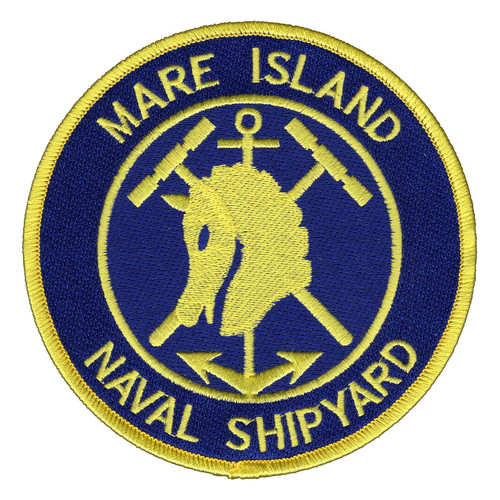
The horse on this patch is the reason the place is called Mare Island. The story told around Vallejo is that a white mare belonging to General Mariano Vallejo went overboard on the Carquinez Strait and swam to the island, and the island took her name. The Navy arrived on 18 September 1854 and built its first base on the Pacific Coast there. Commander David Glasgow Farragut ran the construction and commanded the yard until 1858. For the next 142 years, Mare Island built, repaired and overhauled ships for the Pacific Fleet.
USS Saginaw, launched on 3 March 1859, was the first ship built on the island. USS California BB-44 followed in November 1919, the first super-dreadnought built on the West Coast. Submarine work began with V-6, renamed USS Nautilus SS-168 in 1931, and in 1957 USS Sargo SSN-583 became the first nuclear submarine built on the West Coast. The yard turned out 17 nuclear boats in all, the last being USS Drum SSN-677, launched on 23 May 1970. During World War II it built 391 ships, sent 1,227 repaired ships back to the fight, and kept more than 39,000 civilians on the payroll.
The patch is a 4.5 inch round with a gold merrowed edge around a navy blue field. MARE ISLAND arches across the top in gold block letters and NAVAL SHIPYARD runs along the bottom. Inside a thin gold ring, the head of the mare faces left over a ringed anchor, with two crossed bars behind them. Every element is stitched in the same gold on blue, a plain two-color look that suits a working yard. It has an iron-on backing and can also be sewn on.
Mare Island was a yard of civilians as much as sailors: riveters, welders, pipefitters and draftsmen, with families who worked its shops for generations. Submariners knew it as the place a boat went in tired and came out ready for another patrol. The 1993 Base Closure and Realignment Commission recommended closure, and the base closed on 31 March 1996. The island was transferred to the city of Vallejo in 2002. On the West Coast, the name still opens conversations at any Navy reunion.
Put it in a shadow box beside a photo of the boat you rode out of overhaul or an Inshore Operations Training Center Mare Island patch, or sew it on the jacket you wear to a Vallejo reunion. It also makes a gift for a grandchild whose family built ships on Mare Island Strait. The yard is closed, and the patch keeps its name in the family.
Related Products


