
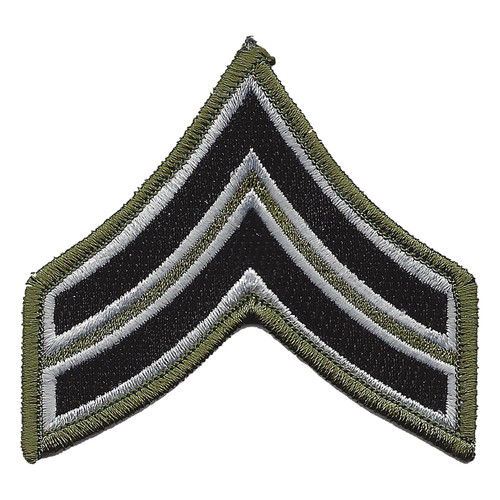
Sheriff Police Corporal Chevrons Black OD Patch
- SKU:
- 11730
- MPN:
- 11730
- Width:
- 3.25 (in)
- Height:
- 3.00 (in)
- Depth:
- 0.08 (in)
- Backing:
- Sew On
- Edging:
- Merrowed Edge


Description
Two stripes, point up, is the corporal's mark across the U.S. Army, the Marine Corps and many American police departments, from the infantry squad to the patrol division. Three stripes is a sergeant. Two is the deputy or officer who has been around long enough to be trusted with a little more, and who still works the same calls as everyone else. Many sheriff's offices and police departments in the United States carried the rank straight over from the military. The corporal is often the first rung of supervision, the one who breaks in new hires and runs a shift when the sergeant is tied up.
Chevrons have marked enlisted rank for more than two centuries. American soldiers and Marines wear them point up, and so do most U.S. police and sheriff's agencies that use them. The corporal's two-stripe pattern carries the same meaning in a squad room as it does in a barracks. Plenty of the men and women who wear it on a duty uniform wore it on a different sleeve first, in the Army or the Marine Corps. The stripe count is the shorthand everyone on a scene reads without thinking.
This set is black chevrons edged in white, with a narrow olive drab stripe between them and an olive drab border. The black and olive drab colorway sits naturally on a green or tan uniform, a field jacket or a range shirt. The white outline makes each stripe stand clear from a distance. There is no lettering, just the rank.
It measures 3.25 inches wide by 3 inches tall, with a merrowed edge, the raised rolled border, in olive drab. The backing is sew-on, so it goes on with a needle or a machine and stays put. It is sized for a uniform sleeve or a display board. The olive drab border keeps the edge from fraying where it meets the cloth.
Put it in a shadow box with a retired badge and a department patch, or on the jacket of a corporal who just made rank. It works as a gift for a new corporal, or for a retired one who wants the stripes he wore on the wall. Two stripes are earned on the street, one shift at a time.
Related Products


