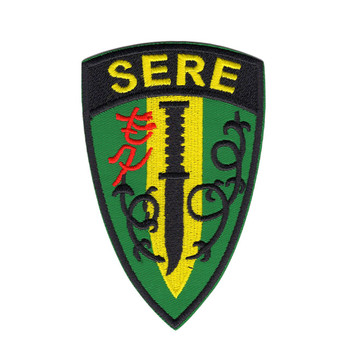
SERE Trained 1985 Survival Evasion Resistance Escape Embroidered Patch

- SKU:
- 268
- MPN:
- 268
- Width:
- 2.50 (in)
- Height:
- 2.50 (in)
- Depth:
- 0.08 (in)
- Backing:
- Iron On
- Edging:
- Merrowed Edge


Description
The SERE curriculum is still classified, but everyone who sat through it knows exactly what the red Chinese characters on this patch mean. Survival, Evasion, Resistance, and Escape -- the four-part framework the U.S. military built from the wreckage of Korea and Vietnam, when returning POWs described interrogation techniques and deprivation conditions that nothing in the existing training pipeline had prepared them for. The school that grew out of those after-action reports became one of the most consequential programs in the American military, mandatory for anyone whose job put them in a high-risk-of-capture billet: naval aviators, Air Force aircrew, Army special forces, and the pipeline of personnel flowing into special operations communities through the 1970s and beyond.
The year marked on this patch -- 1985 -- places it squarely in the late Cold War period, when the threat environments SERE trained against were very much active. The curriculum covered wilderness survival, escape and evasion in denied territory, resistance to exploitation under captivity, and the specific interrogation methods documented from Southeast Asian and Soviet-bloc detention. Instructors who ran the resistance phase operated from real playbooks, not hypotheticals. The Navy ran its course at the SERE School at NAS North Island and later Brunswick. The Air Force ran Code of Conduct training out of Fairchild AFB in Washington. Both drew from the same foundational doctrine, and both produced graduates who understood in their bones what it meant to be on the wrong side of the wire.
The patch is circular, roughly 2.5 inches across, with a gold embroidered field and a dark merrowed border that frames the design cleanly. "SERE" arcs across the top in bold black lettering, "TRAINED" anchors the bottom, and "1985" runs in mirror-image columns along both sides -- a year that places the wearer in a specific moment in the program's history. At the center, three red Chinese characters fill the field, not as decoration but as a deliberate reminder of the threat context this training was designed around. The iron-on backing makes mounting or application straightforward, and the merrowed edge holds its shape through regular handling.
There was no ceremony when SERE ended. Graduates walked out, went back to their squadrons or units, and got on with the job. The patch was never about broadcasting the accomplishment -- it was about the shared recognition among people who knew what the course actually involved. In the communities where SERE qualification was standard, you either had it or you didn't, and the people around you knew the difference. That quiet credibility is what the patch carries, and it reads the same way now as it did in 1985.
Mounted in a shadow box alongside a flight suit patch and a squadron emblem, this piece anchors a specific chapter of a career. It also works as a gift for a son or daughter trying to build a display that actually reflects where their father was and what he went through -- not a generic tribute, but a specific marker. A single patch sometimes says more than a full wall of photographs.
Related Products