
Rosie the Riveter We Can Do It Patch

- SKU:
- 14585
- Width:
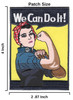
- 2.87 (in)
- Height:
- 4.00 (in)
- Depth:
- 0.08 (in)
- Backing:
- Iron On
- Edging:
- Cut Edge


Description
The We Can Do It! poster hung in Westinghouse plants for only about two weeks in February 1943 before it came down to make room for the next poster in the series. J. Howard Miller painted it for the Westinghouse Electric Corporation, one of at least 40 posters in a run aimed at the company's own workers. Few people outside those plants saw it during the war. Its real audience came forty years later, when it was reprinted in the 1980s and the woman in the polka dot bandana became the face of the home front. Most people now know her simply as Rosie the Riveter.
The name came from somewhere else. Redd Evans and John Jacob Loeb's song "Rosie the Riveter" came out in 1943, and on May 29, 1943, Norman Rockwell put his own Rosie on the cover of the Saturday Evening Post, a woman in a blue jumpsuit with a rivet gun and "Rosie" on her lunch box. The face on Miller's poster likely traces to a photo dated March 1942 of 20-year-old Naomi Parker at work at Naval Air Station Alameda, California, which ran in The Pittsburgh Press that July. Seton Hall professor James J. Kimble found the captioned photo after about five years of searching and published his findings in 2016. For decades the credit had gone to Geraldine Hoff Doyle, a Michigan metal presser, a claim Kimble's research later disproved.
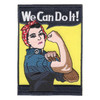
This patch keeps the poster's layout on a 2.87 by 4 inch rectangle. A dark navy speech bubble across the top carries We Can Do It! in white, over the same bright yellow field. Rosie wears her red bandana with white polka dots, a blue work shirt with a round pin at the collar, and a sleeve rolled high as she makes a fist and flexes. Every line of her face and shirt is outlined in black stitching, so she reads like the printed poster from across a room. A dark border frames it all, cut flat at the edge, with an iron-on backing.
American women filled the shipyards, aircraft plants and arsenals during the war, building the ships, bombers and shells the men overseas depended on. Naomi Parker herself was working at a Navy air station when her photo was taken. Many of their sons and daughters went on to serve, and plenty of military families have a Rosie somewhere in the family tree. That flexed arm has become shorthand for a whole generation's work. It honors the women whose labor kept the fleet and the air forces supplied.
Iron it onto a denim jacket, or frame it in a shadow box beside a photo of a grandmother in her coveralls and plant badge. It is a good gift for a mother, daughter or granddaughter who likes to know where she comes from. A faithful take on the poster that came down after two weeks and never really went away.
Related Products


