
REX II P94-2 Air Force Rome Laboratory Ionospheric Research Satellite Patch

- SKU:
- 9162
- MPN:
- 9162
- Width:
- 4.00 (in)
- Height:
- 4.00 (in)
- Depth:
- 0.08 (in)
- Backing:
- Iron On
- Edging:
- Merrowed Edge



Description
REX II carried the Space Test Program designation P94-2 and went to orbit on an air-launched Pegasus XL out of Vandenberg Air Force Base on March 9, 1996. It was an Air Force research satellite sponsored by the Rome Laboratory in New York. Its job was ionospheric research, measuring how the upper atmosphere disturbs the radio signals that satellites send to the ground. This octagon patch commemorates that flight and the teams whose names ring its border.
The first REX went up on a Scout G-1 from Vandenberg on June 29, 1991, catalogued as 1991-045A, and REX II followed as 1996-014A. Both flew for the Air Force Space Test Program and were built on the GemStar bus, with four deployable fixed solar arrays and batteries for power. REX II was built by CTA, weighed about 110 kilograms and settled into a near-polar orbit of roughly 803 by 832 kilometers at an inclination of 89.96 degrees. It held its attitude by gravity gradient, using a 6 meter boom with a 2.5 kilogram tip mass, trimmed by three-axis torque coils. A GPS receiver gave it onboard navigation.
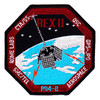
The patch is a 4 inch octagon with a black merrowed border around a maroon band. Inside, the satellite hangs over the curve of the Earth in light blue and white, its grid solar panels open and its long boom reaching up toward REX II stitched in maroon against black space. Two red lightning bolts strike across the Earth below the spacecraft, a fitting nod to the radio signals it was built to study. The border names the team in white: CTA/SS, OSC, ROME LABS, GPS-JPO, SMC/TEL and AEROSPACE, with P94-2 in light blue at the bottom. It has an iron-on backing, and a few stitches around the edge will hold it for good.
Space Test Program missions like this one put Air Force and laboratory experiments into orbit on small rockets, and each one took a mix of military and contractor engineers to get there. Rome Laboratory in upstate New York sponsored the satellite as part of its Air Force research work. REX II was a small satellite with a narrow mission, and the people who built and launched it knew exactly what it was for. The patch lists them by office and company rather than by name. For anyone who worked P94-2, that border is the roster.
It fits a shadow box next to other Space Test Program or Vandenberg launch patches, or the sleeve of a jacket worn by someone who worked at Rome. It is also a good gift for an engineer who spent the mid-1990s on small satellite programs. One small satellite, one Pegasus and a border full of names.
Related Products


