
Pituffik Space Base Embroidered Patch – Formerly Thule Air Base Greenland
- SKU:
- 12969
- MPN:
- 12969
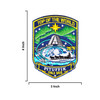
- Width:
- 3.00 (in)
- Height:
- 4.00 (in)
- Depth:
- 0.08 (in)
- Backing:
- Iron On
- Edging:
- Cut Edge


Description
Pituffik Space Base is the northernmost American military installation on Earth, and the pyramid-shaped BMEWS radar dome that once defined Thule Air Base still stands at 76 degrees north as the most recognizable structure on the Greenland ice cap. Originally activated in 1951 as Thule Air Base, the installation spent the Cold War decades as a frontline early warning post, scanning polar approaches for Soviet missiles and later supporting space surveillance missions. In 2023, the Air Force formally redesignated it Pituffik Space Base, transferring it to United States Space Force and marking its evolution from radar outpost to orbital tracking installation. The "Top of the World" call sign has been part of the base's identity for generations, earned simply by geography.
The Ballistic Missile Early Warning System radar at Thule was one of three sites in the global BMEWS network, alongside installations at Clear Space Force Station in Alaska and RAF Fylingdales in the United Kingdom. The 12th Space Warning Squadron has operated the radar there since the Cold War, tracking not just ballistic threats but satellites and space objects. During the height of Cold War tensions the base also supported KC-135 tanker and bomber alert operations, and a 1968 B-52 accident carrying four unarmed nuclear weapons near the base became one of the defining incidents of that era. Pituffik's current mission under Space Force continues the space domain awareness work that made Thule strategically irreplaceable for more than seven decades.
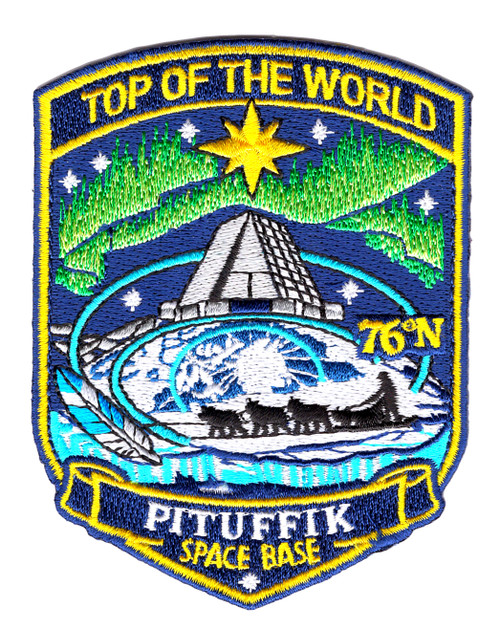
This patch is a shield shape measuring 3 inches wide by 4 inches tall with a cut edge trimmed flat to the embroidery. The deep navy background carries the full arctic scene: green aurora borealis sweeping in two bands across the upper field, an eight-pointed gold star at the apex, and the iconic BMEWS pyramid radar dome centered beneath it all in white and gray. Below the dome, a dog sled rider crosses ice in front of a stylized globe, acknowledging the Inuit heritage of the land the base occupies. The blue jay feather at the center is a deliberate nod to Operation Blue Jay, the classified 1951 construction mission that built this base from scratch in a single Arctic summer. 12,000 men and 120 ships arrived from Norfolk with 300,000 tons of cargo and raised an entire air base 900 miles north of the Arctic Circle before the ice closed in. The coordinate "76 degrees N" appears in gold at the right. "TOP OF THE WORLD" arcs in yellow across the top banner, "PITUFFIK" in white and "SPACE BASE" in gold-outlined text across the bottom scroll. This is an original PopularPatch design, with iron-on backing for direct application to fabric.
An assignment to Thule was not a comfortable tour. The base operates in near-total darkness for months at a time, with wind chills that make outdoor work genuinely dangerous and a supply chain dependent on a single seasonal port window and air resupply. Personnel who served there understood isolation in a way that few other assignments produce. The redesignation to Pituffik Space Base in 2023 was not just a renaming but a recognition of the Greenlandic place name that predates the American presence, a detail that carries its own weight for anyone who studied the history of how the base was established in the first place. What has not changed is the mission: watching the sky from the top of the world.
Mounted in a shadow box alongside Cold War-era memorabilia or Space Force insignia, this patch holds the whole arc of the installation's history in one image. It also works on the vest or jacket worn to a Thule veteran reunion, or as a gift for a family member trying to understand what a posting at 76 degrees north actually looked like. The patch ships ready to iron on or sew on.
Related Products


