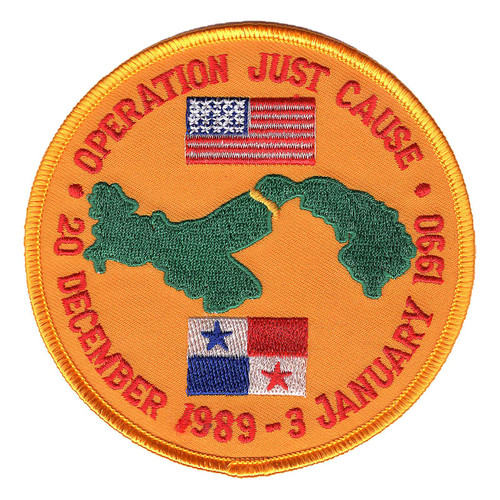
Operation Just Cause Patch
- SKU:
- 5466
- MPN:
- 5466
- Width:
- 4.00 (in)
- Height:
- 4.00 (in)
- Depth:
- 0.08 (in)
- Backing:
- Iron On
- Edging:
- Merrowed Edge


Description
H-Hour was 0100 on 20 December 1989, and by the time the sun came up over Panama, Rangers held Rio Hato and the Torrijos-Tocumen airfields. Operation Just Cause put more than 26,000 American troops into the fight, the largest U.S. military operation since Vietnam. Joint Task Force South ran it, with forces already in Panama and paratroopers flown in through the night from the States. The goal was to protect Americans, secure the canal and bring Manuel Noriega to justice. The dates on this patch run from the first night to the day he walked out and surrendered, 3 January 1990.
A fleet of 148 aircraft launched from Fort Bragg, Fort Benning and Fort Stewart. The 75th Ranger Regiment took the airfields at Rio Hato and Torrijos-Tocumen, and the 82nd Airborne Division's 1st Brigade task force, 1st and 2nd Battalions of the 504th Parachute Infantry, jumped in and joined 3rd Battalion, 504th, already in country. The 193rd Infantry Brigade, with 4th Battalion, 6th Infantry of the 5th Infantry Division (Mechanized), took La Comandancia, the PDF headquarters, while the 7th Infantry Division (Light), Navy SEALs and Marines fought elsewhere across the country. The F-117A Nighthawk saw its first combat here. Noriega took refuge in the Vatican embassy in Panama City and surrendered to U.S. authorities on 3 January 1990.
The patch is round, 4 inches across, with a gold merrowed edge and an iron-on back. The field is gold, lettered in red with OPERATION JUST CAUSE across the top and 20 DECEMBER 1989 - 3 JANUARY 1990 around the bottom, with red dots between. The Stars and Stripes sit above a green map of Panama, the isthmus stretched across the middle with a thin gold line where the canal crosses it. Below the map is the flag of Panama, red and blue quarters with a blue star and a red star. It is a plain, clear record of where and when.
Twenty-three American service members were killed in Just Cause. For the Rangers, the 82nd, the 7th Light Fighters, the 193rd and every aircrew and sailor who took part, Panama meant a night jump, a fight for an airfield or a long night on the streets of Panama City, all inside a few days. Participants received the Armed Forces Expeditionary Medal. The veterans of those two weeks talk about it with the plain pride of people who did a hard job fast. This patch carries their dates.
Put it in a shadow box with an Armed Forces Expeditionary Medal and a unit photo from Howard AFB or Fort Clayton, or on a vest for the next reunion. It is also a good gift for a Ranger, a paratrooper or a Light Fighter who was there in December 1989. Two weeks, two flags, one isthmus.
Related Products