
Operation Earnest Will Expeditionary Service Medal Patch – U.S. Armed Forces Gulf Escort Mission Emblem
- SKU:
- 11562
- MPN:
- 11562
- Width:
- 4.00 (in)
- Height:
- 4.00 (in)
- Depth:
- 0.08 (in)
- Backing:
- Iron On
- Edging:
- Merrowed Edge


Description
Operation Earnest Will began on 24 July 1987, and on its very first escort mission the reflagged tanker Bridgeton struck an Iranian mine about 20 miles west of Farsi Island. The ship was damaged and nobody aboard was hurt, but the convoys had their first lesson on day one. Earnest Will was the U.S. effort to protect Kuwaiti tankers, re-registered under the American flag, from Iranian attack in the Persian Gulf. It has been called the largest naval convoy operation since World War II. It ran until 26 September 1988, and service in it earned the Armed Forces Expeditionary Medal stitched on this patch.
The first escorts were USS Crommelin, Fox, Worden, Kidd and Klakring under Rear Adm. Harold Bernsen, and at one point more than 30 American warships were in the region, with USS Vandegrift escorting the last tanker. Alongside them ran Operation Prime Chance, with Mark III patrol boats, SEAL platoons and the converted oil service barges Hercules and Wimbrown VII serving as mobile sea bases. On 21 September 1987, MH-6 and AH-6 Little Birds of the 160th Special Operations Aviation Regiment helped stop the Iran Ajr while it was laying mines. After a Silkworm missile hit the tanker Sea Isle City in October 1987, four destroyers shelled Revolutionary Guard platforms in the Rostam oil field in Operation Nimble Archer. HM-14 brought its Sea Stallion helicopters, and oceangoing and coastal minesweepers worked the lanes. When USS Samuel B. Roberts (FFG-58) hit a mine on 14 April 1988, the Navy answered four days later with Operation Praying Mantis.
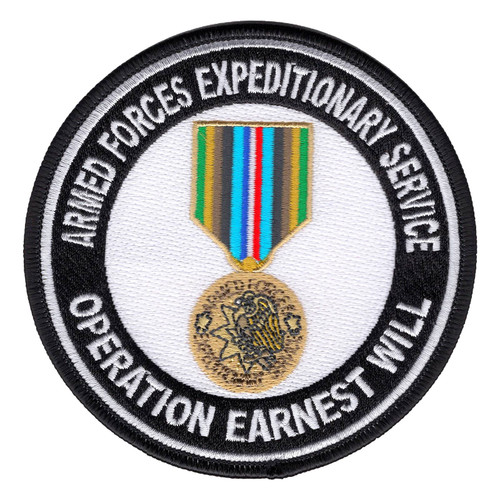
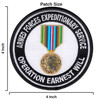
The patch is round, 4 inches across, with a black merrowed edge and an iron-on backing. A black outer band carries ARMED FORCES EXPEDITIONARY SERVICE across the top and OPERATION EARNEST WILL along the bottom in white letters, set off by a thin white ring. On the white center field hangs the medal on its ribbon, stitched in green, gold, brown and black stripes stepping in toward light blue, with the blue, white and red center group. The bronze medal shows an eagle standing on a sword loosened in its scabbard, set on a compass rose. Anyone who has a ribbon rack at home will know those colors from across the room.
This was hard duty in narrow, mined water. A few weeks before the operation formally began, on 17 May 1987, two Exocet missiles struck the frigate USS Stark and killed 37 sailors, and every escort that followed sailed knowing it. Ten sailors were injured when Samuel B. Roberts hit her mine, and her crew fought fire and flooding to keep her afloat. The tankers kept moving, convoy after convoy, through the Strait of Hormuz and up the Gulf to Kuwait. Sailors, Marines, SEALs, Army aviators and Air Force AWACS crews all had a hand in it, and the medal is shared by all of them.
It fits a shadow box beside your ribbon rack and the ship's patch from your Gulf cruise, or the vest you wear to a reunion. It is also a good gift for a shipmate who rode escort in 1987 or 1988 and rarely talks about it. The medal and the operation, named plainly.
Related Products


