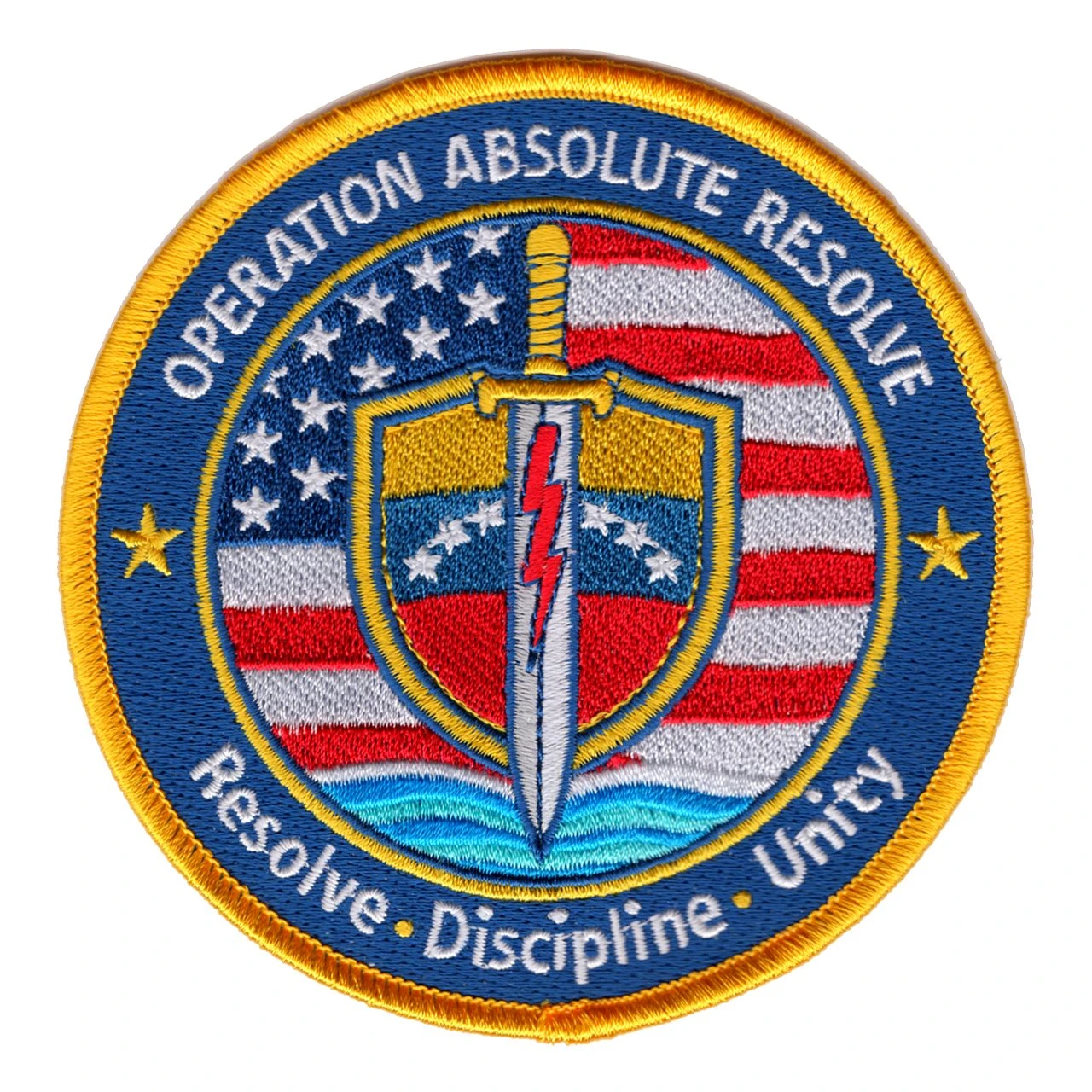
Operation Absolute Resolve Joint Special Operations Commemorative Patch

- SKU:
- 100433
- Width:
- 4.00 (in)
- Height:
- 4.00 (in)
- Depth:
- 0.02 (in)
- Backing:
- Iron On
- Edging:
- Merrowed Edge


Description
Operation Absolute Resolve Commemorative Patch — 4" Embroidered
January 3, 2026. 0201 local time. A pair of MH-60 helicopters from the 160th Special Operations Aviation Regiment crossed into Venezuelan airspace and vanished into the dark between the coastal mountains and the lights of Caracas. Onboard: Delta Force operators who had been rehearsing this exact run, on a full-scale mockup of the target compound, for months. Their job was to grab one man — Nicolás Maduro — and be back over water before the sun came up.
This 4-inch embroidered patch commemorates that mission.
Five Months of Watching Before a Single Rotor Turned
The operation did not start in January. It started the previous August, when the U.S. began building up forces in the southern Caribbean — warships, Marines, fighters pushed into Puerto Rico and the Dominican Republic. A CIA ground team slipped into Venezuela and began tracking Maduro through a source close to him. By the time the Pentagon briefed the President, they knew his daily routine down to the names of his pets, the food he ate, and the route he took between safe houses.
They needed that much detail because Caracas is not Abbottabad. The city sits at the base of a coastal range, ringed by Russian-built S-300s, short-range systems, and Chinese radars — a layered air defense network on paper, with enough teeth to make a helicopter insertion a very bad idea if anything went wrong.
150 Aircraft, One Target
When President Trump gave the go order at 10:46 PM Eastern on January 2, more than 150 aircraft launched across the Western Hemisphere in coordinated waves:
- B-1B Lancer bombers striking Venezuelan air defense infrastructure
- F-22 Raptors out of Joint Base Langley-Eustis, staged through Roosevelt Roads, Puerto Rico — air superiority over Caracas
- F-35A Lightning IIs from the Vermont Air National Guard, specialists in suppressing enemy air defenses
- F-35Bs flown by the Marine Corps
- F/A-18E/F Super Hornets off the USS Gerald R. Ford, the Navy's newest carrier
- EA-18G Growlers blinding Venezuelan radar with electronic attack
- E-2D Advanced Hawkeyes running battle management overhead
- Stealth ISR drones — reportedly including RQ-170 Sentinels — watching the compound in real time
Space and cyber effects layered in on top, carving what General Dan Caine, Chairman of the Joint Chiefs, called a "pathway overhead" for the inbound force. Venezuela's radars went blind before they ever got a good look.
The Raid
The Night Stalkers put the assault force on the ground at Maduro's compound in downtown Caracas. The ground team moved fast. Trump, watching the feed live, said Maduro tried to bolt for a safe room and did not make it. He and his wife, Cilia Flores, were on the helicopters within minutes.
The extraction is where it got loud. On the way out, the helicopters took ground fire. One was hit but kept flying. Caine later said the force answered with overwhelming force and that there were multiple self-defense engagements as they pushed back toward the coast. Every aircraft and every American made it home.
At 3:29 AM Eastern, the force was feet wet over open water, Maduro and Flores in custody aboard the USS Iwo Jima. Start to finish, the kinetic phase lasted under three hours — the product of five months of intelligence work, a full-scale rehearsal compound, and the integration of air, sea, space, cyber, and ground forces that only the United States can put in the air on short notice.
About the Patch
- 4-inch fully embroidered patch
- Merrowed border for clean edges and long service life
- Iron-on backing standard; hook-and-loop available on request
Whether you're an operator, a supporter, or a collector, this patch marks one of the most complex direct action operations in U.S. history — and the most significant one conducted in Latin America since Panama in 1989.
Related Products