Navy Submarine Silent Service Dolphins Patch
- SKU:
- 80
- MPN:
- 80
- Width:
- 4.25 (in)
- Height:
- 3.25 (in)
- Depth:
- 0.08 (in)
- Backing:
- Iron On
- Edging:
- Merrowed Edge


Description
The two fish flanking the boat on this patch are dolphinfish, the mahi-mahi, the same pair that has rested its heads on the bow planes of every set of submarine dolphins since 1924. Captain Ernest J. King proposed a submarine device in the summer of 1923 while commanding Submarine Division Three. The Bureau of Navigation had a Philadelphia jewelry design firm draw the final version. Acting Secretary of the Navy Theodore Roosevelt Jr. approved it for wear on 24 March 1924. Every qualified submariner since has worn that bow view of a boat on his uniform.
The submarine in the middle of the dolphins is a bow-on view of a surfaced O-class boat, the type in service when the device was drawn. From 1924 to 1947, qualified enlisted men wore an embroidered version on the right sleeve, and a 1941 photograph of a machinist's mate first class at Naval Submarine Base New London shows it there. In 1947 enlisted dolphins moved to the left breast. When officers were authorized gold embroidered dolphins in 1950, enlisted submariners could wear a silver metal pin. The look has barely changed in a century, which is why a qualified man spots a set across a room.
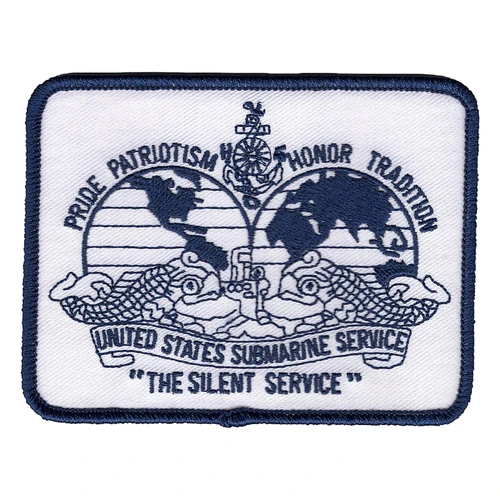
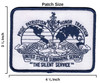
This patch is a rectangle with rounded corners, 4.25 inches wide by 3.25 inches tall, stitched in a single navy blue thread on white twill with a navy merrowed edge. Arched across the top it reads PRIDE PATRIOTISM on the left and HONOR TRADITION on the right. Two hemispheres of the globe sit behind a ship's wheel topped with an eagle and fouled anchor, and below them the dolphins frame the submarine bow. A banner reads UNITED STATES SUBMARINE SERVICE, and under it, in quotes, "THE SILENT SERVICE." The back is iron-on.
Earning dolphins means qualifying on the boat, learning its systems well enough to act on your own when it counts, and having qualified men sign off on you. That shared test is why submariners from any era can sit down together and understand each other in a few sentences. The Silent Service name comes from the work itself: boats that sail alone, say little and come back without telling anyone where they went. Families learned to live with long patrols and short letters. The dolphins are the outward mark of all of it.
Sew or iron it onto a jacket or vest for a base reunion, or frame it with a boat patch and a set of dolphins in a shadow box. It also makes a good gift for a submariner, or for the son or grandson who grew up hearing about the boats. Plain navy and white, the way the Navy did things.
Related Products