Navy Nurse Corps Patch
- SKU:
- 9953
- MPN:
- 9953
- Width:
- 3.00 (in)
- Height:
- 3.00 (in)
- Depth:
- 0.08 (in)
- Backing:
- Iron On
- Edging:
- Cut Edge


Description
The 1908 on the scroll is the year Congress created the Navy Nurse Corps, by an act signed on May 13, 1908. The first twenty nurses, remembered as the Sacred Twenty, reported to the Naval Medical School Hospital in Washington, D.C., and had to find their own housing and meals. Esther Voorhees Hasson was the first Superintendent, serving from 1908 to 1911. Lenah H. Sutcliffe Higbee followed her and led the corps through World War I. From that small start, the Nurse Corps grew into a corps of officers that goes wherever sailors and Marines need care.
World War I grew the corps fast, and nineteen Navy nurses died on active duty, more than half of them from influenza. Four Navy nurses received the Navy Cross for that war, three of them posthumously, and the fourth went to Higbee, the first living woman to receive it. Navy nurses took the first permanent shipboard billets aboard the hospital ship USS Relief (AH-1) in 1920. In World War II, Chief Nurse Marion Olds and four nurses were captured on Guam, and Chief Nurse Laura Cobb and her nurses were held at Los Banos in the Philippines until American forces freed them in 1945. Korea brought USS Haven (AH-12) and her sister ships to the casualty line, and in Vietnam nurses served aboard USS Repose (AH-16) from 1966 and USS Sanctuary (AH-17) from 1967.
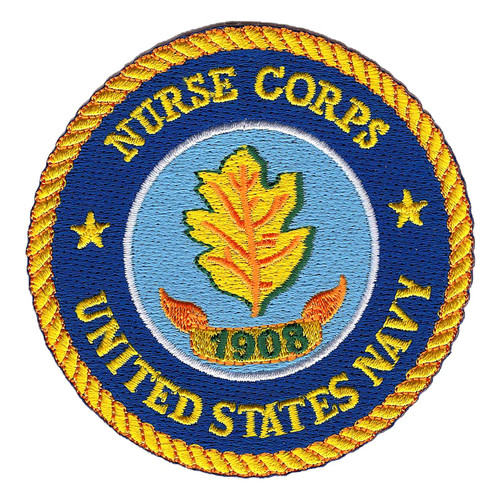
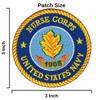
This is a 3-inch round patch with a cut edge and a twisted gold rope border. NURSE CORPS arches across the top of a dark navy band and UNITED STATES NAVY runs along the bottom, in gold letters with a gold star at each side. Inside a white ring, a light blue center holds a gold oak leaf with orange veins and a green outline. The oak leaf is the Nurse Corps device, the leaf a Navy nurse wears on the collar and on shoulder boards where a line officer wears a star. Beneath it, an orange and gold scroll carries the year 1908.
Navy nurses have worked the wards of naval hospitals at home and overseas, and the decks of hospital ships from Relief to Repose. Nurses captured on Guam and in the Philippines kept caring for patients as prisoners. In 1972 Alene B. Duerk, a Navy nurse, became the first woman in the Navy promoted to flag rank. Ask a sailor or Marine who woke up aboard a hospital ship, and he remembers the nurse.
Mount it in a shadow box with her ribbons and oak leaf collar device, or put it on a jacket or bag for a Navy nurse reunion. It is also a good gift for a newly commissioned Navy nurse or for one who retired years ago. The patch has an iron-on backing and can also be sewn on. The corps has been on duty since 1908.
Related Products