Naval Computer and Telecommunications Station Guam Patch
- SKU:
- 27527
- MPN:
- 27527
- Width:
- 4.00 (in)
- Height:
- 4.00 (in)
- Depth:
- 0.08 (in)
- Backing:
- Iron On
- Edging:
- Cut Edge


Description
Navy communications on Guam started immediately after the island was retaken in the 1944 Battle of Guam, and the station has been on the air ever since. It began as Naval Communications Station Guam, NCS Guam, and over the decades has also been called NCS Finegayan and NCTS Finegayan after the ground it sits on. For years it carried the title of Naval Computer and Telecommunications Area Master Station Western Pacific, NCTAMS WESTPAC. Today it is Naval Computer and Telecommunications Station Guam, NCTS Guam. Sailors who stood watch there know it simply as the comm station on the north end of the island.
The station sits on the North Finegayan Telecommunications Site of Naval Base Guam, along Guam Highway 3 in Dededo, on the island's northwest coast. In 2000 the master station duties of NCTAMS WESTPAC and NCTAMS EASTPAC were merged into NCTAMS PAC at Honolulu, and the Guam site was redesignated an NCTS. It reports through NCTAMS PAC to the U.S. Tenth Fleet and provides communications support for the Third, Fifth and Seventh Fleets. The site was home to one of the 14 Cold War AN/FRD-10 Wullenweber antenna arrays, the big circular arrays shut down in 1999, and hosts the Guam Remote Ground Terminal for the Tracking and Data Relay Satellite System. In 2020 Marine Corps Base Camp Blaz was activated next door.
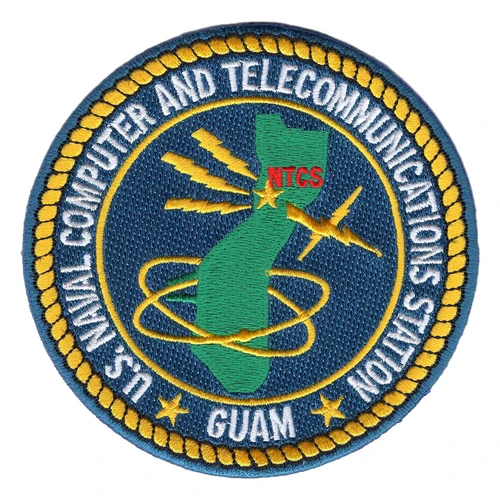
This is a 4 inch round patch with a cut edge, a blue rim and a gold rope border. U.S. NAVAL COMPUTER AND TELECOMMUNICATIONS STATION arcs around the top in white letters, with GUAM at the bottom between two gold stars. Inside a gold ring, the island of Guam is stitched in green, with a gold star near its northern end marking the station and red lettering beside it. Gold lightning bolts radiate from the star for radio traffic, and gold orbit rings loop around the island for the satellite side of the mission. The blue and gold are Navy colors, and the back is iron-on.
Duty at a Navy comm station is quiet work that never stops. The watch at Guam kept traffic moving for ships and aircraft across the Western Pacific, through every typhoon season and every change of name on the gate. Radiomen, information systems technicians and the technicians who kept the antenna fields up all passed through Finegayan. Many of them remember the Wullenweber array on the skyline before it came down. The station has carried the Navy's traffic in the Pacific for more than 80 years and is still on the air.
It fits a shadow box with a sailor's ribbons and a photo from Finegayan, or a jacket or sea bag that went west of the date line. It is also a good gift for a shipmate who did a tour on Guam and still talks about the island. Press it on, or stitch it down for good. One island, one station, and a lot of traffic passed through both.
Related Products