
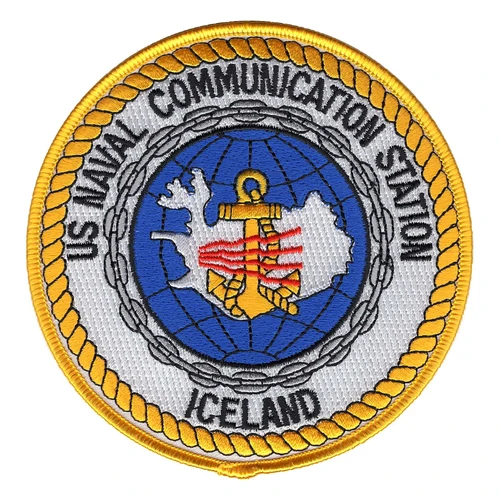
Naval Communication Station Iceland Patch
- SKU:
- 6831
- MPN:
- 6831
- Width:
- 4.50 (in)
- Height:
- 4.50 (in)
- Depth:
- 0.08 (in)
- Backing:
- Sew On
- Edging:
- Merrowed Edge



Description
The red waves running across this anchor are the signal that went out from Grindavik, where the Navy's longwave masts, one of them 1,000 feet tall, put the station's broadcast on the air from the edge of the North Atlantic. U.S. Naval Communication Station Iceland was established at Keflavik on 1 July 1961 and took over most of the island's military communications. For the Cold War Navy, Iceland sat in the middle of the GIUK gap, and the messages that moved through this station kept ships, aircraft and submarines connected. Sailors who stood the watch there remember wind, dark winters and a mission that never shut down. This patch is theirs.
The station picked up the communications load from the Air Force's AACS and MATS when it stood up in 1961. Its remote sites included Naval Radio Transmitter Facility Grindavik, which transmits on longwave and shortwave under the callsign TFK on 37.5 kHz and maintains submarine broadcast equipment. The receiver site moved in 1968, and the Rockville receiver site was fully remoted in March 1997 before closing in October 1999. In late 1991 the command was redesignated a Naval Computer and Telecommunications Station. It was one of the major tenant commands on the base, separate from the host command, Naval Air Station Keflavik, which closed on 30 September 2006.
The patch is round, 4.5 inches across, with a gold merrowed edge and a sew-on backing. A gold twisted line runs around the white outer field, with US NAVAL COMMUNICATION STATION across the top and ICELAND across the bottom in black. Inside, a gray chain circles a blue globe gridded in black. The white outline of Iceland fills the globe, with a gold fouled anchor at its center and three red radio waves streaming across it. Line, chain and anchor frame the island, and the waves show what the station sent out.
Iceland duty was a remote tour with a reputation. Sailors went out to transmitter and receiver sites in weather that could shut the roads, and kept circuits up for the patrol planes and ships working the North Atlantic. The base had its own culture, from the White Falcon newspaper to the long summer daylight and the winter dark. Communicators who served there carried that experience to every station after. The Grindavik transmitter stayed in service after the base closed, later run as a detachment of NCTAMS LANT.
It belongs in a shadow box with your Keflavik photos, a NAS Keflavik patch and the radioman or IT rating badge you wore. It also fits a jacket or a reunion vest. It makes a good gift for a shipmate who stood the watch in Iceland, or for a family who spent a tour at Keflavik. Iceland sailors know the cold was only half the story.
Related Products


