Naval Aviator Pilot Wings Patch Gold
- SKU:
- 1897
- MPN:
- 1897
- Width:
- 4.00 (in)
- Height:
- 1.50 (in)
- Depth:
- 0.08 (in)
- Backing:
- Iron On
- Edging:
- Cut Edge


Description
The Navy approved wings for its aviators in the fall of 1917, and that October it settled on a single color for them: gold. Bronze had been proposed first, then gold and silver together, then all silver, before gold won. The device was a fouled anchor with spread wings and a shield across it, and it has changed very little since 1922. Lieutenant Commander John H. Towers, one of the Navy's first aviators, and Lieutenant Henry Reuterdahl helped shape it. Bailey, Banks and Biddle of Philadelphia made the first pins, which arrived in December 1917.
The October 1917 regulation, Change 14 to the 1913 Uniform Regulations, set the device for naval aviators, and a 1920 change opened the wings to qualified warrant officers and enlisted men. Early pins were engraved with the aviator's name and his naval aviator number, a practice dropped during World War I. The 1922 regulations allowed the wings in gold embroidery or in gold-plated bronze, 2 3/4 inches tip to tip. During World War II small dots or circles began to show where the wings break, in place of the fine feathering on the first pins. The same gold went on the chests of the men who flew F6F Hellcats and F4U Corsairs in the Pacific, A-4 Skyhawks and F-4 Phantom IIs over Vietnam, F-14 Tomcats through the Cold War, and F/A-18 Hornets and Super Hornets after them.
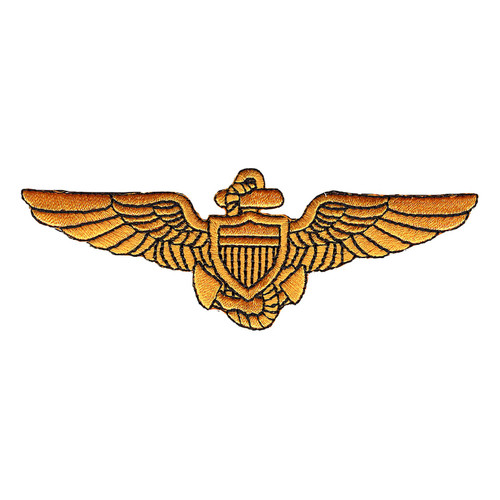
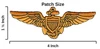
This patch is the wings in gold thread, 4 inches wide and 1.5 inches tall, every feather row picked out in black stitching. Each wing sweeps out long and nearly level from the center. The anchor stands upright behind a shield, its ring at the top looped with line, its stock showing above the shield and its flukes curling out below. The shield carries a solid band across the top over a field of vertical stripes. It is cut edge and trimmed right to the silhouette, so there is no background at all, only the wings.
Gold wings mean one thing to anyone who wears them: the pilot finished naval flight training and was designated a naval aviator. The training today runs through the Naval Air Training Command, from the T-6B Texan II to the T-45C Goshawk for the jet pipeline, and carrier qualification means putting an aircraft down on a moving deck and catching a wire. Marines and Navy pilots come out of the same schools and pin on the same gold. The device has stayed nearly the same for a century, so a grandson's wings look like his grandfather's. That continuity is a large part of why aviators keep them long after they stop flying.
Sew it on the flight jacket or put it in a shadow box with a logbook page, squadron patches and the date you were winged. It also makes a good gift for a son or daughter just designated, or for a retired aviator who still keeps his old jacket in the closet. The backing is iron-on, and it can be sewn on for a permanent hold. Gold, as it has been since 1917.
Related Products