
Naval Air Station Sigonella Patch
- SKU:
- 1445
- MPN:
- 1445
- Width:
- 5.00 (in)
- Height:
- 4.50 (in)
- Depth:
- 0.08 (in)
- Backing:
- Iron On
- Edging:
- Merrowed Edge



Description
The first Americans to arrive at Sigonella in March 1959 had no buildings to move into, so they ran the job out of a warehouse in Catania for six months. Naval Air Facility Sigonella was formally established on 15 June 1959 under its first commanding officer, Captain Walter J. Frazier. By the end of August the NAF II airfield was open for daylight flights and 24 had been logged. The base sits on the Catania plain in eastern Sicily, about 40 kilometers south of Mount Etna. In the 1980s it became a Naval Air Station and picked up the name every sailor who passed through it knows, the Hub of the Med.
Sigonella started because P2V Neptune patrol operations were outgrowing Hal Far on Malta, and on 25 June 1957 Italy made the land available to the Navy. Within a week LSTs were bringing equipment over from Malta, and the first U.S. aircraft arrived from Naples on 8 August 1957. In 1965 the Italian Air Force based its 41st Antisubmarine Warfare Wing, the 41 Stormo, on the same field. On the night of 10 October 1985, during the Achille Lauro crisis, Navy F-14 Tomcats directed the Egyptian airliner carrying the hijackers down at Sigonella. The base supported Operation Odyssey Dawn over Libya in 2011, and today a rotating P-8A Poseidon patrol squadron flies from NAS II alongside more than three dozen tenant commands.
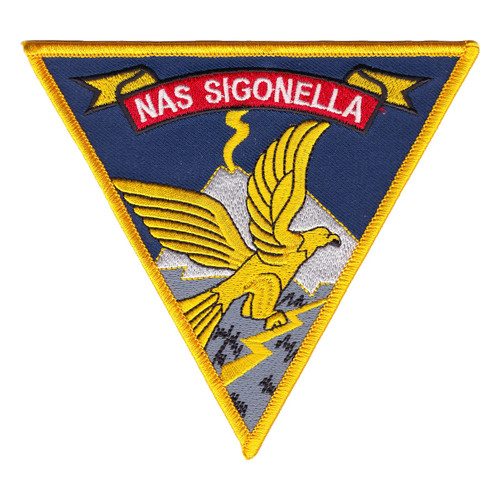
The patch is an inverted triangle 5 inches wide and 4.5 inches tall, with a gold merrowed edge around a navy blue field. Across the top, NAS SIGONELLA is stitched in white on a red scroll with gold ends. Below it a gold eagle with spread wings comes down on a lightning bolt, talons out. Behind the eagle rises a white and gray peak with a plume of smoke curling off the top, Etna as the flight line saw it on a clear day. Lightning marks run down the gray slope into the point of the triangle. The back is iron-on.
For the patrol crews, maintainers, hospital staff and families who lived there, Sigonella was a small American town at the crossroads of the Mediterranean. NAS I held the Exchange, the Commissary, the school and some housing, and NAS II held the runways and the squadrons, with the drive between them part of daily life. Neptunes gave way to P-3 Orions and later to the P-8A, and the ramp saw a steady flow of transient aircraft headed east, west and south. The Navy, the Italian Air Force and NATO all fly from the same field. Anyone who did a tour there remembers the volcano on the skyline and the long days on the ramp.
It fits a flight jacket or a squadron vest, and it sits well in a shadow box with the VP squadron patches from a Sigonella deployment. It also makes a good gift for a shipmate who was stationed in Sicily or a son who was born at the Naval Hospital there. A plain triangle, an eagle, and Etna behind it.
Related Products


