
Naval Air Station Jacksonville Florida Patch

- SKU:
- 328
- MPN:
- 328
- Width:
- 5.50 (in)
- Height:
- 5.00 (in)
- Depth:
- 0.08 (in)
- Backing:
- Iron On
- Edging:
- Merrowed Edge



Description
The Blue Angels were established at NAS Jacksonville under Butch Voris, and the team called the station home before moving to Corpus Christi in the late 1940s. The station itself was commissioned on 15 October 1940. Its ground had been Camp Joseph E. Johnston, where the Army trained quartermasters in 1917, and later Camp Foster for the Florida National Guard. Commander Jimmy Grant made the first landing on the unfinished runway that September. During World War II more than 10,000 pilots and 11,000 airmen earned their wings of gold there.
The Navy's first jet carrier air groups arrived in 1948, and by April 1949 the station was called the East Coast's aircraft capital, with more naval aircraft than any base from Nova Scotia to the Caribbean. In 1973 Helicopter Antisubmarine Wing One came aboard, and antisubmarine warfare became the station's primary mission. Today Patrol and Reconnaissance Wing Eleven runs the P-8A Poseidon squadrons VP-5, VP-8, VP-10, VP-16, VP-26, VP-45 and VP-62. VP-30, the fleet replacement squadron, is the Navy's largest aviation squadron, and VUP-19 flies the MQ-4C Triton. On the helicopter side, HSM-46, HSM-70, HSM-72 and HSM-74 fly the MH-60R Seahawk.
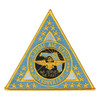
The patch is a triangle 5.5 inches wide and 5 inches tall, light blue with a gold merrowed edge and an iron-on backing. Gold stars climb both sides toward the peak and run along the base, with white panels set in the corners. In the center, a round seal reads U.S. NAVAL AIR STATION across the top and JACKSONVILLE, FL. across the bottom in gold. Inside it, a light blue outline of Florida sits on a dark navy field, with gold rays fanning out from the northeast corner of the state, right where the station sits on the St. Johns River. Gold wings with an anchor and shield spread across the middle, and WE SERVE THE FLEET is stitched in gold beneath them.
Those four words fit the place. Fleet Readiness Center Southeast, which began as Naval Air Rework Facility Jacksonville, has more than 5,000 people and is the largest employer in Northeast Florida and southern Georgia. Generations of aircrew, maintainers and sailors rotated through the station between patrols, deployments and overhauls. Marines served here too, until the last unit left in 1986. For many Navy families, Jax was home for more than one tour.
It fits a shadow box beside a VP or HSM squadron patch and a set of wings, or on the jacket worn to a reunion back in Jacksonville. It also makes a good gift for anyone whose father or grandfather earned his wings here during World War II. Sew it on for the long haul, or press it on with the iron-on backing. One station, one motto, stitched in gold.
Related Products


