STEREO Solar Terrestrial Relations Observatory NASA Mission Patch
- SKU:
- 10578
- MPN:
- 10578
- Width:
- 4.00 (in)
- Height:
- 4.00 (in)
- Depth:
- 0.08 (in)
- Backing:
- Iron On
- Edging:
- Merrowed Edge


Description
STEREO launched two nearly identical spacecraft on a single Delta II, and the Moon split them up, sending one ahead of Earth and the other behind it. The name is short for Solar TErrestrial RElations Observatory, and the capital letters spell the point of the mission. With two cameras looking at the Sun from two places at once, NASA could see it in stereo, the same way two eyes give a person depth. The pair left Pad 17B at Cape Canaveral at 8:52 p.m. Eastern on October 25, 2006. The Johns Hopkins University Applied Physics Laboratory built the spacecraft.
On December 15, 2006, both spacecraft swung past the Moon. STEREO-A came out of it on a path around the Sun inside Earth's orbit, which put it ahead of Earth. STEREO-B met the Moon a second time on January 21, 2007, and settled into an orbit just outside Earth's, falling behind. The two drifted apart by roughly 44 degrees a year and were a quarter of the way around the Sun from each other by January 24, 2009. Each carried the SECCHI imaging suite with its EUVI imager, coronagraphs and heliospheric imagers, plus the IMPACT, PLASTIC and S/WAVES instruments for particles, plasma and radio waves. The first three-dimensional views of the Sun came back in March 2007.
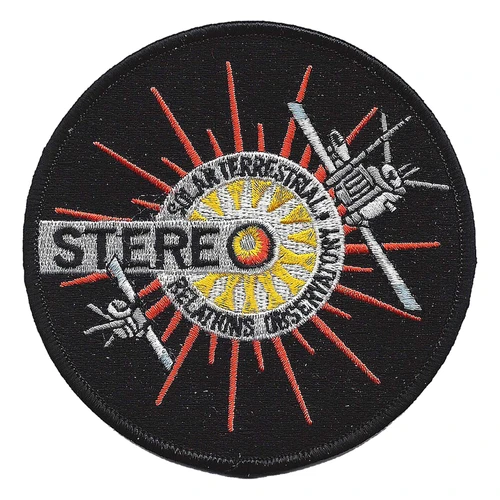
This is a 4 inch round patch on black twill with a black merrowed border. A sun sits in the center, white with yellow rays, ringed in black lettering that reads SOLAR TERRESTRIAL over the top and RELATIONS OBSERVATORY along the bottom. STEREO runs in from the left on a silver bar, and the red and yellow bull's-eye at the heart of the sun is the last O. Long red rays burst out across the black field. Two silver spacecraft with outstretched solar panels hang on opposite sides of the sun, one high and one low, the two points of view the whole mission was built on. It has an iron-on backing, and a few stitches around the border will keep it on for good.
STEREO was planned as a two-year mission and kept going far longer. Contact with STEREO-B was lost on October 1, 2014, during a planned reset, and the team heard from it only briefly in August 2016. NASA ended the recovery effort in October 2018. STEREO-A kept working on its own and made its closest pass by Earth in August 2023. For the engineers and scientists at APL and Goddard, the two spacecraft on this patch are years of watching the Sun from places no one had watched it from before.
It fits a shadow box with other NASA heliophysics patches or a framed 3D image of the Sun. It is also a good gift for a solar physicist, an amateur astronomer or anyone who worked on the mission. Two spacecraft, one Sun, and a view nobody had before 2006.
Related Products