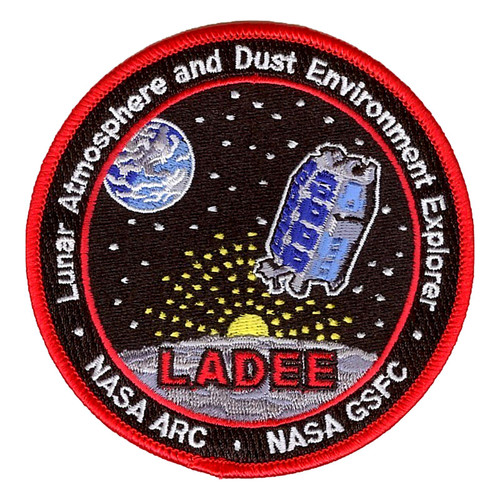
LADEE Lunar Atmosphere and Dust Environment Explorer NASA Mission Patch
- SKU:
- 10568
- MPN:
- 10568
- Width:
- 4.00 (in)
- Height:
- 4.00 (in)
- Depth:
- 0.08 (in)
- Backing:
- Sew On
- Edging:
- Merrowed Edge


Description
On September 6, 2013, LADEE launched from NASA's Wallops Flight Facility in Virginia, the first deep space mission ever launched from Wallops. The name stands for Lunar Atmosphere and Dust Environment Explorer, and its job was to study the Moon's very thin atmosphere and the dust around it. NASA's Ames Research Center in California designed, built and tested the spacecraft, and ran the mission after launch. Goddard Space Flight Center in Greenbelt, Maryland, managed the science instruments, the technology demonstration payload and the science operations center. Those two centers are the NASA ARC and NASA GSFC stitched along the bottom of this patch.
The rocket was a Minotaur V integrated by Orbital Sciences, launching from Pad 0B at the Mid-Atlantic Regional Spaceport, and LADEE was the first payload ever carried by an Air Force Minotaur V. The spacecraft entered lunar orbit on October 6, 2013, and was later brought down to a science orbit between 20 and 60 kilometers, 12 to 37 miles, above the surface for a 100-day science phase. It carried a Neutral Mass Spectrometer, an ultraviolet and visible light spectrometer and the Lunar Dust Experiment, along with the Lunar Laser Communication Demonstration, which sent data from lunar orbit by laser at 622 megabits per second in October 2013. The mission ended as planned on April 18, 2014, UTC, when LADEE struck the far side of the Moon near the eastern rim of Sundman V crater. In 2015 the science team announced neon in the lunar exosphere and named helium, neon and argon as its most abundant gases.
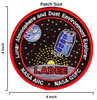
The patch is a 4 inch circle with a rolled red merrowed border and a black outer ring. Lunar Atmosphere and Dust Environment Explorer runs around the top in white, with NASA ARC and NASA GSFC across the bottom between small white dots. Inside a thin red ring, the blue and white Earth hangs among white stars at the upper left, and the boxy blue LADEE spacecraft, its sides covered in solar panels, tilts at the right. Below it the Sun breaks over a gray lunar horizon in a spray of gold points, with LADEE in big red block letters across the surface. It has a sew-on backing.
LADEE was a small mission by NASA standards, about $280 million from development through operations, and it rode on a new Modular Common Spacecraft Bus that had never been to space before. It took a team of centers to fly it: Ames for the spacecraft and operations, Goddard for the instruments and science operations, Wallops for the launch and Marshall managing it within the Lunar Quest Program. Controllers at Ames confirmed the impact at 10:59 p.m. Pacific time on April 17, 2014. By then LADEE had finished its 100-day science phase and done what it was sent to do.
It fits a shadow box beside an Apollo or Lunar Reconnaissance Orbiter patch, or on a jacket worn to a launch at Wallops. It also makes a good gift for a student headed into planetary science or anyone who watched a rocket go up from the Virginia coast. It is one small orbiter that went from the Virginia coast to the Moon.
Related Products