
NAS Cubi Point Bataan Philippines US Navy Naval Air Station Patch

- SKU:
- 9073
- MPN:
- 9073
- Width:
- 4.00 (in)
- Height:
- 4.00 (in)
- Depth:
- 0.08 (in)
- Backing:
- Iron On
- Edging:
- Merrowed Edge



Description
The runway stitched across this patch sits on ground the Seabees made, cutting into the mountain and filling Subic Bay as deep as 98 feet. Civilian contractors had called the job impossible. Admiral Arthur W. Radford, Commander in Chief of the Pacific Fleet, saw the need for a jet air station there during the Korean War and pushed it through anyway. Naval Air Station Cubi Point was commissioned on July 25, 1956, and the Navy still calls it the single largest earth-moving project it has ever undertaken. For the carrier aviators of the Seventh Fleet it became the repair shop and supply depot of the Western Pacific.
Mobile Construction Battalion 3 arrived in October 1951, MCB-5 followed within weeks, and MCB-2, MCB-9 and MCB-11 came after, along with Construction Battalion Detachments 1802 and 1803. The Seabees excavated 23 million cubic yards of earth for the airstrip, moved 15 million cubic yards of hydraulic fill and quarried a million cubic yards of rock. MCB-2 took about 85 feet off the top of Mount Maritan to clear the glide path, and Radford rode in the first aircraft to land on the paved strip on April 22, 1953. Once open, Cubi Point was the primary maintenance, repair and supply center for the 400 carrier-based aircraft of the Seventh Fleet, and during the Vietnam War its jet engine shop turned out two engines a day. On December 21, 1972, the station was renamed for Radford, who dedicated the facility in person.
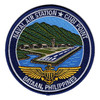
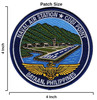
The patch is 4 inches round with a navy blue merrowed edge, and the scene inside is Cubi Point itself. A green ridge fills the upper half, the same high ground the battalions cut down. Below it a dark blue runway runs out over the water on rock-faced fill, with the control tower and a line of hangars at the foot of the hill. Gold Naval Aviator wings with an anchor and striped shield cross the bottom under NAVAL AIR STATION CUBI POINT, with BATAAN, PHILIPPINES lettered below. It has an iron-on backing and can be sewn on if you would rather.
Anyone who came through the Western Pacific remembers the Officers' Club on the hill above the station, its walls covered in squadron memorabilia. Mount Pinatubo erupted about 20 miles away on June 15, 1991, and left the station under roughly a foot of ash. The Navy completed its withdrawal in November 1992. Before the handover the club's squadron memorabilia was taken down and shipped to the National Naval Aviation Museum in Pensacola, where it has decorated the Cubi Bar Cafe since 1996. The airfield is Subic Bay International Airport today.
Most of these end up in a shadow box with cruise patches and a set of wings, or on the vest that comes out for the squadron reunion. It also makes a good gift for a son or grandson who has heard the Cubi stories and never had anything to put with them. A mountain, a runway and a set of gold wings.
Related Products


