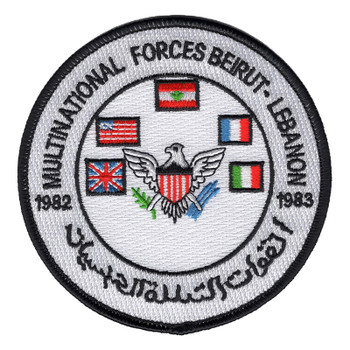
Multinational Peacekeeping Force Beirut Lebanon Patch

- SKU:
- 13252
- MPN:
- 13252
- Width:
- 4.00 (in)
- Height:
- 4.00 (in)
- Depth:
- 0.08 (in)
- Backing:
- Iron On
- Edging:
- Merrowed Edge


Description
The black plume on the left of this patch belongs to Italy's Bersaglieri, and the red beret on the right is a paratrooper's, because the Multinational Force that went into Beirut in 1982 was never only American. The American helmet at the top of the circle sits over the cedar of Lebanon. Below them runs a band of flags. French troops came ashore on 21 August 1982, U.S. Marines on 25 August and the Italians on 26 August, sent to see the PLO fighters out of the city. Within weeks they were back, and the second force stayed for a year and a half.
The first landing put the 32nd Marine Amphibious Unit ashore at the port of Beirut beside French and Italian troops. After that force withdrew, the Marines returned in late September 1982, and Marine Amphibious Units rotated through the airport positions for the next seventeen months. The French sent paratroopers and Foreign Legion regiments, Italy sent Folgore paratroopers, Bersaglieri and San Marco marines, and in February 1983 Britain added an armoured reconnaissance squadron of the 1st The Queen's Dragoon Guards in Ferret armoured cars. On 23 October 1983 suicide truck bombs killed 241 American servicemen at the headquarters of Battalion Landing Team 1/8 with the 24th Marine Amphibious Unit, and 58 French paratroopers at the Drakkar building. The battleship USS New Jersey BB-62 arrived off the coast in September 1983 and fired her 16-inch guns in December and again on 8 February 1984. The Italians left on 20 February 1984, the Marines on 26 February and the last French troops on 31 March.
The patch is a 4 inch round with a red merrowed edge and an iron-on backing. MULTINATIONAL PEACEKEEPING FORCE arches across the top in black letters on white, and BEIRUT and LEBANON run along the bottom separated by a dot. Inside a thin red ring the green cedar with its brown trunk stands at the center, the tree on Lebanon's flag. The olive drab American helmet rides above it, the white helmet with the black Bersaglieri feathers sits to the left, and a red beret hangs to the right. Along the bottom a gold-trimmed band carries the colors of Italy, the United States and France.
Beirut was a peacekeeping mission with the rules of a peacekeeping mission and the dangers of a war zone. Marines stood post at the airport under sniper fire and shelling, and the men of the 24th MAU lost more Marines in a single morning than the Corps had lost on any day since Iwo Jima. The French lost more paratroopers that day than on any day since the Algerian War. The memorial at Camp Lejeune carries the words They Came in Peace. Veterans of every contingent share that bond, and this patch puts all of them in one circle.
Mount it in a shadow box with a Navy Unit Commendation, a Beirut photo or a set of dog tags, or wear it on the vest you take to October 23 memorial services. It also makes a meaningful gift for a Beirut veteran, or for the son or daughter of a Marine or sailor who did not come home from the airport. The cedar and the flags tell the story without a word of explanation.
Related Products