
Multinational Forces Beirut Lebanon 1982-1983 Patch

- SKU:
- 2971
- MPN:
- 2971
- Width:
- 4.00 (in)
- Height:
- 4.00 (in)
- Depth:
- 0.08 (in)
- Backing:
- Iron On
- Edging:
- Merrowed Edge
- Era:
- Cold War


Description
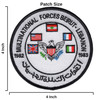
Count the flags on this patch and you get five: the United States, France, Italy and the United Kingdom, the four nations that sent troops, with Lebanon's cedar flag at the top. The Multinational Force went ashore in Beirut in August 1982 to see the PLO out of the city, left in September, and came back within weeks. U.S. Marines held the area around Beirut International Airport, with French, Italian and later British troops in their own sectors. The mission was presence, and the rules of engagement kept it that way. Every Marine and sailor who served there remembers what that meant.
French troops landed on August 21, 1982, the Marines of the 32nd Marine Amphibious Unit on August 25, and the Italians on August 26. Yasser Arafat sailed on August 30, and the force reboarded its ships on September 9 and 10. After President-elect Bashir Gemayel was killed on September 14, the Multinational Force returned, with the Marines back ashore on September 29, 1982. The 24th, 22nd and 31st MAUs rotated through after the 32nd, and a British armored reconnaissance squadron joined in February 1983. On October 23, 1983, truck bombs struck the Marine barracks and the French paratroopers' building, killing 241 American servicemen and 58 French paratroopers, and the battleship USS New Jersey BB-62 later fired her 16-inch guns in support of the force.
The patch is 4 inches round with a black merrowed edge around a light gray band. MULTINATIONAL FORCES BEIRUT - LEBANON arcs across the top in black, with 1982 on the left, 1983 on the right and a line of Arabic script along the bottom. Inside, a white disc holds the five flags around a white spread-winged eagle with a red-and-white striped shield. A green olive sprig sits at one side of the eagle and a spray of blue at the other. It has an iron-on backing and can be sewn on.
Beirut was a peacekeeping deployment, and it cost more American lives in one morning than any single day for the Marine Corps since Iwo Jima. The men who served there stood post under orders that asked a great deal of their discipline. They kept standing it after October 23, alongside French, Italian and British troops doing the same. The Marines withdrew in February 1984 and the rest of the force followed by spring. The years on this patch are the ones they spent on the ground.
Put it in a shadow box with your Navy or Marine Corps Expeditionary Medal and a photo from the airport perimeter, or on the vest you wear to Beirut Veterans gatherings. It also makes a good gift for a Marine who was there, or for a family who lost someone on October 23. Five flags, two years, one city.
Related Products


