Multi-National Force Iraq MNF-I Patch
- SKU:
- 100258
- Width:
- 4.00 (in)
- Height:
- 4.00 (in)
- Depth:
- 0.08 (in)
- Backing:
- Iron On
- Edging:
- Merrowed Edge
- Era:
- Afghanistan & Iraq (GWOT)


Description
Multi-National Force-Iraq took over from Combined Joint Task Force 7 in May 2004, and for the next five and a half years it was the top coalition headquarters in the country. MNF-I sat above Multi-National Corps-Iraq, which ran operations day to day, and Multi-National Security Transition Command-Iraq, which built and trained the Iraqi Army and police. Troops from dozens of nations served under it at one time or another. On 1 January 2010 it was folded, along with its subordinate commands, into United States Forces-Iraq. Anyone who wore this patch served during the hardest stretch of Operation Iraqi Freedom.
Gen. George W. Casey Jr. took command on 1 July 2004 and held it until 10 February 2007. Gen. David H. Petraeus followed and led MNF-I through the surge until 16 September 2008. Gen. Raymond T. Odierno, who had commanded Multi-National Corps-Iraq during the surge, then held the job until the change to USF-I on New Year's Day 2010. Under the headquarters in Baghdad sat Multi-National Corps-Iraq, Multi-National Security Transition Command-Iraq and Task Force 134, the detainee operations command, and all of them were retired at the same ceremony. The work ran from clearing operations to standing up Iraqi security forces that could hold ground on their own.
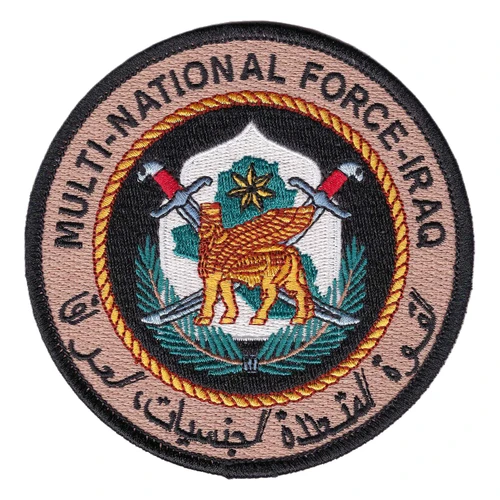
The patch is a 4-inch circle with a black merrowed border and a tan outer band. MULTI-NATIONAL FORCE-IRAQ arcs across the top in black block letters, and the force's name runs along the bottom in Arabic script, a reminder that this was a headquarters working alongside Iraqis. Inside a gold rope ring, a gold winged lion stands over a green map of Iraq set on a white arch, with a black and gold star above. Two curved swords with red grips cross behind the lion, and green palm fronds close around the base. The winged figure is the lamassu, the guardian of ancient Assyria, a civilization that grew up in the same river valleys the coalition worked in.
MNF-I service meant long tours, a mission that changed as the years went on, and partners from many flags. British troops formed the largest allied contingent and Poland led a multinational division in south-central Iraq, working beside American soldiers, Marines, sailors and airmen. For many who served, the MNF-I patch was also the combat patch on the right sleeve. It is the emblem of the headquarters that set the course of the war from 2004 through 2009, and the men and women under it carried that course out on the ground.
It belongs in a shadow box next to an Iraq Campaign Medal, a unit coin, an Operation Iraqi Freedom patch and the patch from your division or brigade. It also irons or sews onto a deployment jacket or a range bag. As a gift, it suits a veteran who spent a year at Camp Victory or another Iraq base and still talks about the people he served with. A 4-inch patch for the command that ran the coalition for five and a half years.
Related Products