
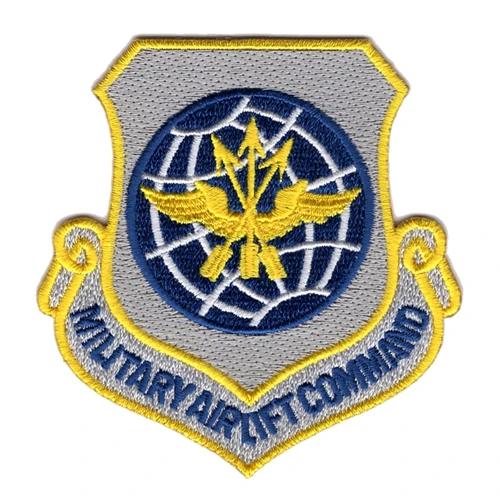
Military Airlift Command MAC Patch
- SKU:
- 2101
- MPN:
- 2101
- Width:
- 3.00 (in)
- Height:
- 3.00 (in)
- Depth:
- 0.08 (in)
- Backing:
- Iron On
- Edging:
- Cut Edge


Description
The three gold arrows behind the eagle stand for the three armed services, and they are older than the command lettered on the scroll below them. They came forward from the Military Air Transport Service, the joint outfit that ran long range airlift from 1948 until the Air Force replaced it with Military Airlift Command on 1 January 1966. MATS flew with Navy VR squadrons in the formation, which is why the count is three and not one. Headquarters was Scott Air Force Base, Illinois. MAC owned strategic airlift only until December 1974, when the tactical airlift wings came over and one command finally owned every cargo airplane the Air Force had.
That consolidation put the C-130 Hercules under Scott's control alongside the C-141 Starlifter and the C-5 Galaxy. The big jets had already answered the question in October 1973 on Operation Nickel Grass, the 32 day resupply of Israel, where C-5s carried 48 percent of the tonnage in 145 of the 567 missions flown. They took the loads nothing else could, M60 Patton tanks, M109 howitzers, CH-53 Sea Stallions. France and West Germany closed their fields to those flights, so the whole thing routed through Lajes Field in the Azores, and the lesson stuck: every C-141 got a refueling receptacle during the stretch program between 1977 and 1982. In February 1983 Air Force special operations came under MAC as 23rd Air Force, flying MC-130s out of Hurlburt Field. When Iraq took Kuwait in August 1990, every C-141 and C-5 in the inventory went on the line, Reserve and Guard crews included, and the first 22 days of Desert Shield moved more tonnage than the entire eleven month Berlin Airlift.
The shield is the standard Air Force major command shape, silver gray, with a gold border that follows every curve of the silhouette down through the curled ends of the scroll. Inside it sits a dark blue globe crossed with white grid lines, and the grid is the point. MAC's world was a route structure, Scott to Rhein-Main to Lajes to Clark to Yokota, measured in flying hours and crew rest. The gold eagle spreads across that globe with the three arrows rising behind it, and MILITARY AIRLIFT COMMAND runs across the scroll in blue block letters. It is three inches square, cut edge, iron on backing, and it will take a needle if you would rather sew it.
MAC's reputation was never built on speed or glamour. It was built on the airplane showing up. The C-141 became the airborne ambulance out of Vietnam, running casualties to Clark Air Base, on to Japan, and home to hospitals in the States, and for a lot of men the first clear thing they remember after being hit is the inside of a Starlifter. On 12 February 1973 a C-141A of the 63rd Military Airlift Wing out of Norton AFB landed at Gia Lam outside Hanoi and carried out the first 40 prisoners of war released by North Vietnam. Crews called that airplane the Hanoi Taxi, and 54 more Operation Homecoming missions brought out 591 men by early April. MAC inactivated on 1 June 1992, and Scott AFB kept the mission under a new name.
It sits well in a shadow box next to the Air Mobility Command patch that replaced it, so the whole run from 1966 forward reads in one frame. It also goes on the vest for a wing reunion, or to a son who has heard about Rhein-Main and Clark but has never seen where they sat on a map. The airplanes are in museums now. The patch is still the shorthand.
Related Products


