Marine Corps Beirut Lebanon They Came In Peace 30th Anniversary Embroidered Patch

- SKU:
- 11898
- MPN:
- 11898
- Width:
- 4.00 (in)
- Height:
- 4.00 (in)
- Depth:
- 0.08 (in)
- Backing:
- Iron On
- Edging:
- Merrowed Edge



Description
The four words arched across the top of this patch are the same four words cut into the granite outside Camp Johnson in Jacksonville, North Carolina. They Came In Peace. The Beirut Memorial was dedicated on October 23, 1986, three years to the day after a truck loaded with explosives drove into the Battalion Landing Team headquarters at Beirut International Airport at 6:22 on a Sunday morning. Two hundred forty one American service members died there, 220 Marines, 18 sailors and three soldiers. It was the worst single day the Corps had seen since Iwo Jima, and this patch carries the number 241 in plain black thread directly below the figure at its center.
The ground element was Battalion Landing Team 1/8, the 1st Battalion, 8th Marines, inside the 1,800 man 24th Marine Amphibious Unit, redesignated the 24th Marine Expeditionary Unit in 1988. Marines first went ashore in August 1982 to cover the PLO evacuation, came back that September, and spent the next seventeen months holding the airport perimeter and the ground along the Green Line alongside French, Italian and British troops. Six kilometers from the BLT building that same Sunday morning, a second truck brought down the Drakkar in Ramlet al Baida and killed 58 French paratroopers of the 1st and 9th Parachute Chasseur Regiments. Offshore, USS Iwo Jima LPH-2 was the casualty receiving ship, and helicopters put 65 of the critically wounded on her deck inside ninety minutes of the blast. USS New Jersey BB-62 came on station with the Sixth Fleet and later fired her 16 inch guns on Druze and Syrian batteries in the hills above the city. The last Marines assigned to the multinational force pulled out of Beirut on February 26, 1984, which is why the ring of this patch reads 1982 on one side and 1984 on the other.
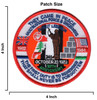
The patch is round, four inches across, with a red merrowed border rolled up thick enough to feel under your thumb. Four national flags sit in the white outer ring, the Union Jack and the Stars and Stripes above, the French and Italian tricolors below, the four countries that made up the force. The center disc is burnt orange, and on it is a lone figure in helmet and full combat gear, head down, rifle upright, framed between a dark slab and a pale one the way the memorial statue in Jacksonville stands between two broken walls. To his right the gray blocks step down on themselves, four stories of concrete aviation administration building that came apart in a few seconds. Left of him is the outline of Lebanon in red and white with the green cedar, and above that the Eagle, Globe and Anchor. Across the bottom runs a black banner, OCTOBER 23 1983, with a green thirtieth anniversary scroll beneath it.
Beirut reshaped how the Corps handles force protection, standoff distance and post security, and Marines trained since have worked under lessons paid for that morning. The men there were peacekeepers by mandate, holding fixed positions in a city where the lines shifted week to week, under rules written for a peacekeeping mission rather than a fight. Beirut veterans have carried that quietly for four decades, longer than most of them expected to have to. Every October 23 the names are read aloud at the memorial in Jacksonville, and the French and American survivor associations still observe the date together. The bottom of this patch says the first duty is to remember, and among the men who were there that line does real work.
Most of these end up in a shadow box beside a set of dress blues or on the back of a vest worn to the annual gathering in Jacksonville. Some get sent to a son or a grandson who knew the date mattered but never got the whole story out of the old man. The backing is iron on, so it presses onto a jacket or a range bag in a couple of minutes, and it takes a needle fine if you want it permanent. Four inches of thread that says 241, October 23, 1983, and nothing further needs saying.
1 Review
-
Good quality and timely delivery.
I was a photo journalist in Beirut when the embassy was destroyed. This has special meaning and I am pleased with the craftmanship.
Related Products