LPD-3 USS La Salle Patch

- SKU:
- 4007
- MPN:
- 4007
- Width:
- 4.00 (in)
- Height:
- 4.00 (in)
- Depth:
- 0.08 (in)
- Backing:
- Iron On
- Edging:
- Merrowed Edge


Description
On 3 November 1966, USS La Salle (LPD-3) hoisted the Gemini 2 test capsule out of the South Atlantic near Ascension Island. That was a long way from the amphibious work she was built for, and it set the pattern for a ship that never stayed in one role for long. La Salle was the third of the Raleigh-class amphibious transport docks, built at the New York Naval Shipyard in Brooklyn and commissioned on 22 February 1964. She was named for La Salle, Illinois, which carries the name of the explorer Rene-Robert Cavelier, Sieur de La Salle. This patch is from her LPD years, before she turned white and moved to the Persian Gulf.
Under Capt. Edward H. Winslow she left Norfolk on 9 October 1964 for Operation Steel Pike I, the big NATO-linked landing exercise off Huelva, Spain, then joined the 6th Fleet at Naples before coming home in March 1965. On 1 May 1965 she sailed for the Caribbean with Vice Admiral John S. McCain Jr. embarked and later served with the Caribbean Amphibious Ready Squadron. Built to carry up to 750 Marines and their landing craft in a floodable well deck, she worked the Atlantic, the Gulf coast and the Caribbean, and in November 1968 she deployed again to the Mediterranean with the 6th Fleet. In 1972 she was converted and redesignated AGF-3, a miscellaneous command ship, and homeported in Bahrain as flagship of the Middle East Force. Painted white for the heat, she became known as the Great White Ghost of the Arabian Coast.
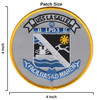
The patch is a 4 inch circle on a light gray field with a gold merrowed edge. USS LA SALLE rides on a black and gray ribbon across the top, with LPD3 on a blue bar beneath it. An anchor runs behind the shield, its ring above and its flukes showing below the scroll. The shield is split by a white diagonal band, with a white ship riding blue waves on one side and a yellow sun and a branching white line on black on the other. A blue scroll with a Latin motto curves along the bottom, the colors gray, blue, black and gold all the way through.
La Salle spent four decades doing whatever the Navy needed from her hull. In 1979 she helped evacuate 260 civilians from Bandar Abbas, and in May 1987 her crew gave the primary firefighting and rescue help to USS Stark after the Iraqi missile attack. In 1990 she commanded and coordinated the multinational Maritime Intercept Force during Desert Shield. Later she went back to gray and served as the Sixth Fleet flagship out of Gaeta, Italy, until USS Mount Whitney relieved her in February 2005. She was decommissioned at Norfolk on 27 May 2005, and her LPD sailors and her Gulf sailors share the same ship.
Hang it in a shadow box with a La Salle cruise book and a Steel Pike or Mediterranean photo, or wear it on a jacket to a ship's reunion. It is also a good gift for a father or grandfather who rode her in the 1960s with the Marines aboard. The iron-on backing presses onto denim or canvas, and stitching it on adds hold for years of wear. LPD-3, the ship that started amphibious and ended up commanding fleets.
Related Products