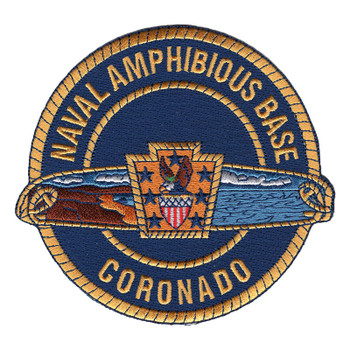
Little Creek Amphibious Base Patch

- SKU:
- 968
- MPN:
- 968
- Width:
- 4.00 (in)
- Height:
- 4.00 (in)
- Depth:
- 0.08 (in)
- Backing:
- Iron On
- Edging:
- Merrowed Edge


Description
Little Creek started on July 16, 1942, when a Navy truck pulled into a waterlogged bean field on the Whitehurst family farm. Within a few years that farmland in Princess Anne County had become four separate training bases: Camp Bradford, Camp Shelton, the U.S. Naval Frontier Base and the Amphibious Training Base. More than 200,000 sailors and 160,000 soldiers and Marines learned the amphibious trade there during World War II. On August 10, 1945, the four were folded into one installation and commissioned as Naval Amphibious Base Little Creek. It was made a permanent base in 1946, and for the next six decades it was the East Coast home of the amphibious Navy.
The wartime crews that came through Little Creek trained on the landing ship medium (LSM), the landing craft infantry (LCI) and the landing craft utility (LCU), and Camp Bradford turned out crews for the landing ship, tank (LST) from 1943. After the war the base became home to Naval Beach Group Two, with Assault Craft Unit Two, Assault Craft Unit Four and Beachmaster Unit Two, along with Amphibious Construction Battalion Two. Naval Special Warfare Group Two and its SEAL Teams 2, 4, 8 and 10 work out of Little Creek, as do the Special Boat Teams of Naval Special Warfare Group Four and Explosive Ordnance Disposal Group Two. On October 1, 2009, the base merged with the Army's Fort Story to form Joint Expeditionary Base Little Creek-Fort Story. Today it supports some 27 homeported ships and more than 15,000 people on the south shore of the Chesapeake Bay in Virginia Beach.
This is a round patch, 4 inches across, with a heavy gold rope ring stitched just inside a navy merrowed edge. Aboard ship that rope is line, and nobody who served at Little Creek needs reminding of that. NAVAL AMPHIBIOUS BASE arcs across the top in navy letters on white, LITTLE CREEK runs along the bottom, and a small navy star sits on each side. The center is a blue globe crossed with grid lines, with green ground and rolling surf on both sides, which is the whole amphibious idea in one picture: the sea meeting the shore. A brown eagle with spread wings perches on a gold anchor, a red, white and blue ribbon winding down through the anchor shank and onto the beach. The patch has iron-on backing.
Ask an amphibious sailor where he trained and a lot of them will say Little Creek before you finish the question. The base taught the Navy how to put troops and equipment on a beach, and it kept teaching that lesson through every era that followed. Beachmasters, boat crews, Seabees and SEALs all claim the place, and so do the gator Navy ships that tied up at its piers. The 2009 merger with Fort Story changed the name on the gate, but the men who trained there still call it Little Creek. For a lot of East Coast sailors, it is where the Navy started for them.
It fits a shadow box next to the ship patches from a career in the amphibious Navy, or a vest worn to a beach group or boat unit reunion. It also makes a good gift for a sailor who reported to Little Creek fresh out of A school, or for a son who wants to know where his father learned to run a landing craft. The patch comes ready to iron on to a jacket or bag. Little Creek trained the crews who put the Navy on the beach.
Related Products