
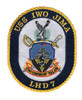
LHD-7 USS Iwo Jima Amphibious Assault Ship Patch

- SKU:
- 1677
- MPN:
- 1677
- Width:
- 4.00 (in)
- Height:
- 5.00 (in)
- Depth:
- 0.08 (in)
- Backing:
- Iron On
- Edging:
- Cut Edge




Description
Two Navy ships have carried the name Iwo Jima, and this crest belongs to the second: LHD-7, commissioned 30 June 2001. The scroll reads UNCOMMON VALOR, from Admiral Nimitz's line that at Iwo Jima "uncommon valor was a common virtue." The shield behind it holds the moment every American knows without a caption, the flag going up over Mount Suribachi on 23 February 1945. A ship named for the Corps' hardest-won island is crewed by Sailors and loaded with Marines on purpose. The crossed swords on the crest, one Navy officer's sword and one Marine NCO sword, say the same thing in steel.
She is a Wasp class amphibious assault ship, sister to the USS Wasp LHD-1 that leads the class, built to put Marines ashore by well deck and flight deck at the same time. In September 2005 she steamed up the Mississippi and moored in downtown New Orleans as the command platform for Hurricane Katrina relief, her flight deck the only fully working airfield in the city. Over a thousand flight deck evolutions ran off her in those weeks, most of them helicopters hauling survivors, supplies, and rescue crews. In March 2012 she deployed as flagship of her amphibious ready group with the 24th Marine Expeditionary Unit embarked. Between the headline moments came Mediterranean and Fifth Fleet deployments and the unglamorous daily work that gator Navy Sailors recognize from any era.
The patch is a 4 by 5 inch oval, cut following a gold rope border that rings a dark navy field. USS IWO JIMA arcs over the top in gold and LHD 7 sits below, framing a white center oval. The eagle stands atop the crest with the crossed swords beneath it, the Suribachi flag raising in black silhouette on the blue shield, and gold rays breaking across the black lower half. The red-trimmed gold scroll carries the motto. The backing is iron on, and it will take a needle if you would rather sew it.
The first Iwo Jima, LPH-2, served from 1961 to 1993, and this hull picked the name up eight years later, which is how the Navy keeps faith with a battle it will not let fade. Aboard an LHD the ship's company and the embarked Marines run to different chains of command and the ship works anyway, cruise after cruise. Amphibious sailors rarely get the headlines the carriers get, and the ones who served aboard her know exactly what the well deck sounded like at 0300 anyway. The name on the stern carries more weight than most hulls ever get asked to hold.
It mounts well in a shadow box beside a MEU patch or a cruise ball from a Mediterranean deployment. It also goes to the Sailor or Marine in the family who can tell you what an LCAC sounds like from the vehicle deck. The battle is in the history books. The ship that carries its name is still working.
Related Products


