LHA-2 USS Saipan Omnia Facimus Patch
- SKU:
- 8527
- MPN:
- 8527
- Width:
- 4.50 (in)
- Height:
- 4.50 (in)
- Depth:
- 0.08 (in)
- Backing:
- Iron On
- Edging:
- Merrowed Edge


Description
OMNIA FACIMUS is Latin for "we do it all," and on an amphibious assault ship that carried a Marine battalion, its helicopters and a well deck full of landing craft, the motto was a plain job description. USS Saipan LHA-2 was the second of five Tarawa-class amphibious assault ships, built by Ingalls Shipbuilding in Pascagoula, Mississippi. She was commissioned on 15 October 1977 and homeported at Naval Station Norfolk for nearly thirty years. Her name honors the 1944 Battle of Saipan in the Marianas. Sailors and Marines who rode her called her a gator, like every big-deck amphib in the fleet.
Saipan's keel was laid on 21 July 1972 and she was launched on 20 July 1974. In 1983 she was off Grenada for Operation Urgent Fury, and in 1990 she led Operation Sharp Edge, evacuating about 1,600 civilians from war-torn Liberia. She deployed to the Persian Gulf after Desert Storm, worked the Adriatic during Operations Deny Flight and Provide Promise in 1993, and in 1998 carried the 22nd Marine Expeditionary Unit through evacuation and security missions in Kinshasa and Tirana. In 1999 she served as a test platform for the MV-22 Osprey. She sailed for Operation Iraqi Freedom in January 2003 and made her last deployment to the Persian Gulf in 2006.
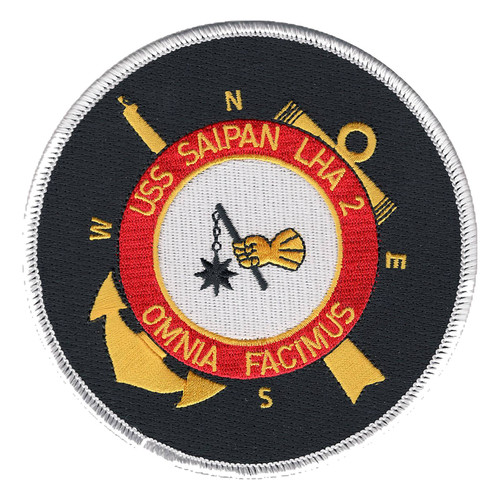
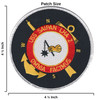
The patch is a 4.5 inch circle with a white merrowed edge around a black field. Gold compass points mark north, east, south and west around the rim. A gold anchor crosses a gold rifle behind the center, the sailor's tool and the Marine's tool on one deck. A red ring carries USS SAIPAN LHA 2 across the top and OMNIA FACIMUS along the bottom in gold. In the white center, a gold mailed fist grips a black flail with its chain and spiked ball, the mailed fist ready to strike from the sea.
Saipan was decommissioned at Naval Station Norfolk on 20 April 2007, after 29 years of service. A Tarawa-class LHA carried a Marine battalion landing team with its helicopters, Harriers and landing craft, and her crew lived inside the Navy-Marine Corps team every day. From the Liberia evacuation to the Gulf, she was the ship that showed up when Americans needed to get out or Marines needed to go in. Plankowners who joined her at Pascagoula in 1977 and the last crew at Norfolk in 2007 share the same motto. They did it all, for 29 years.
Press it onto a jacket or sea bag with the iron-on backing, or stitch around the merrowed edge for a lasting hold. It belongs in a shadow box next to a cruise book and a 22nd MEU patch, or on a vest at a gator Navy reunion. It is a good gift for a sailor or Marine who rode her through the Med or to the Gulf for Operation Iraqi Freedom. Omnia Facimus, stitched in gold.
Related Products