Joint Special Operations Command JSOC Mini Patch
- SKU:
- 5591
- MPN:
- 5591
- Width:
- 1.63 (in)
- Height:
- 2.00 (in)
- Depth:
- 0.02 (in)
- Backing:
- Iron On
- Edging:
- Merrowed Edge


Description
The Joint Special Operations Command was established on 15 December 1980, less than eight months after eight American servicemen died at Desert One in Iran. Operation Eagle Claw, the attempt to rescue the American hostages held in Tehran, ended in the desert on the night of 24 April 1980. The Army, Navy, Air Force and Marine Corps had each sent forces, and the whole task force had never run a full rehearsal together. A Joint Chiefs review group led by retired Admiral James L. Holloway III recommended a standing joint task force with its own staff and assigned forces. JSOC was the answer, and it has been headquartered at Fort Bragg, North Carolina, ever since.
Eagle Claw had brought together Army operators of 1st Special Forces Operational Detachment-Delta, Air Force MC-130 Combat Talons and EC-130s, and Navy RH-53D Sea Stallion helicopters launched from USS Nimitz in the Arabian Sea. JSOC was built so that the next time those pieces would already know each other. Its forces went into Grenada in Operation Urgent Fury in 1983, into Panama in Operation Just Cause in 1989, and into Somalia in Operation Gothic Serpent in 1993. When deployed as part of JSOC task forces, units such as the 75th Ranger Regiment and the 160th Special Operations Aviation Regiment work under its control. The command sits under U.S. Special Operations Command, which was created in 1987. Most of what it has done since stays out of the papers, and that is how the people in it prefer it.
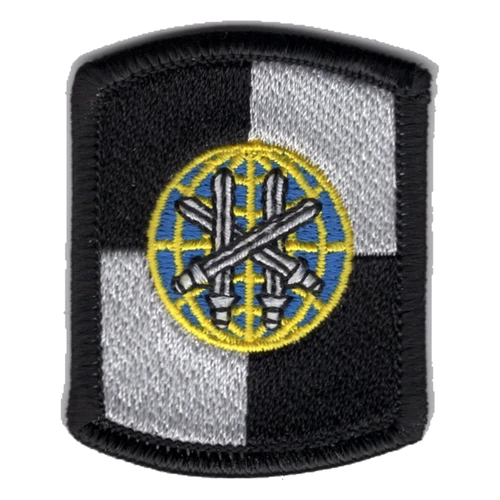
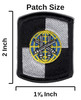
This one is small, 1 5/8 inches wide by 2 inches tall, in the shoulder sleeve insignia shape with flat sides and an arched top and bottom. A black merrowed edge rolls around a field quartered in black and silver gray. In the center sits a blue globe with gold grid lines, ringed in gold. Four silver swords cover the globe, two standing upright and two crossed over them. A gridded world under crossed blades says what the command was built for, reach anywhere on the map. At this size it goes places a full-size patch will not fit.
JSOC carries the lessons of Desert One in everything it does. The eight men who died there, five airmen and three Marines, are remembered by the operators who came after them. The command drew its people from every service and asked them to work as one team under a single headquarters. Very little about that work is ever made public, and the people who did it rarely talk about it. Wearing the name is a quiet way of saying you were part of it, or that you know someone who was.
The iron-on backing presses onto a cotton or canvas surface, and a few stitches around the merrowed edge will hold it for heavy use. It fits a shadow box beside the full-size Joint Special Operations Command patch, a backpack strap, a laptop sleeve or the collar of a field jacket. For someone who spent time at Fort Bragg in a joint billet, it is a small reminder that does not need to explain itself. A small patch for a command that keeps a low profile.
Related Products