
US Army Pathfinder Badge Torch and Wing Patch
- SKU:
- 9286
- MPN:
- 9286
- Width:
- 3.00 (in)
- Height:
- 2.00 (in)
- Depth:
- 0.08 (in)
- Backing:
- Iron On
- Edging:
- Merrowed Edge


Description
Pathfinders went in first, and the first of them jumped into combat in Italy on 13 September 1943 to mark the drop zones for the paratroopers coming behind them. Early airborne operations had scattered men miles from their objectives, at night and in bad weather. The fix was a small team that landed ahead of everyone else and made the ground findable. On 6 June 1944 pathfinder teams jumped into Normandy ahead of the airborne divisions. The torch on this badge says the job in one picture: they lit the way for the men behind them.
The first Pathfinder Badge was drawn in May 1944 by Lt. Prescott, a navigator in the 9th Troop Carrier Pathfinder Group (Provisional), and it was worn by pathfinder paratroopers and by the IX Troop Carrier Command aircrews who guided the transports and towed the gliders. They wore it on the left sleeve of the service coat, four inches above the cuff. The current badge was approved on 22 May 1964, made first in cloth and, from 11 October 1968, in enameled metal as well. Vietnam saw the largest use of pathfinders the Army ever had, because the helicopter methods worked out by the 11th Air Assault Division (Test) put a pathfinder detachment in nearly every aviation battalion. Their work was setting up parachute drop zones and helicopter landing zones, rigging sling loads and talking aircraft in.
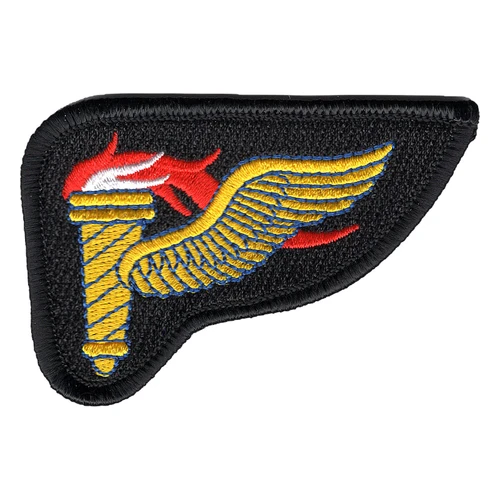
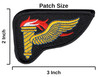
This is a 3 by 2 inch patch cut to the outline of the badge, with a black twill field, a black merrowed edge following the full curve, and an iron-on backing. A gold torch stands upright on the left, its flame stitched in red with a white highlight streaming back over the top. A single gold wing sweeps out from the torch to the right, its feathers picked out in fine blue outline stitching, with a last tongue of red flame trailing below the tip. The wing stands for flight and airborne capability and the torch for leadership and guidance, the two halves of a pathfinder's work. Gold on black reads clearly on a dark jacket or a light shadow box mat.
A pathfinder's work is measured by whether everyone else lands where they were meant to. A wrong drop zone puts a battalion in the wrong place, and a badly run landing zone puts aircraft and crews at risk. The course runs two weeks today, condensed from three, and covers land navigation on foot, sling loads and air traffic control for helicopters and fixed-wing aircraft. The badge is small and the community is smaller, which is part of why the men who wear it know each other on sight.
Mount it in a shadow box with jump wings or an air assault badge, or sew it to the vest worn to a division reunion. It is also a good gift for a soldier just back from the course, or for a Vietnam pathfinder whose old detachment patch is long gone. A torch and a wing, and every pathfinder knows the rest.
Related Products


