
Iceland Defense Force Patch
- SKU:
- 13403
- MPN:
- 13403
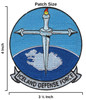
- Width:
- 3.50 (in)
- Height:
- 4.00 (in)
- Depth:
- 0.08 (in)
- Backing:
- Iron On
- Edging:
- Cut Edge


Description
The first Iceland Defense Force personnel arrived at Keflavik on 7 May 1951, two days after Iceland and the United States signed the defense agreement that brought them back. Iceland had joined NATO in 1949 but kept no army of its own, and the IDF filled that gap for the next fifty-five years. It was a sub-unified command of the Department of Defense, headquartered at Naval Air Station Keflavik on the Midnesheidi plateau. By the 1980s Navy, Air Force and Marine Corps people made up most of the force, alongside a few Army and Coast Guard personnel. From 1961 on the commander was a Navy rear admiral, and the job carried NATO titles along with it.
Air defense came first. The 57th Fighter-Interceptor Squadron flew F-102 Delta Daggers and then F-4 Phantom IIs out of Keflavik, and F-15 Eagles replaced the Phantoms in July 1985. Over the Cold War, alert crews made more than 1,000 intercepts of Soviet aircraft inside Iceland's air defense identification zone. Below the surface, Naval Facility Keflavik monitored the SOSUS hydrophone network from 1966 to 1996, while rotating P-3 Orion squadrons flew antisubmarine patrols until 2004. E-3 AWACS crews rotated through in the 1980s, the 85th Group ran the Air Force side, and the 56th Rescue Squadron stood rescue alert over the North Atlantic.
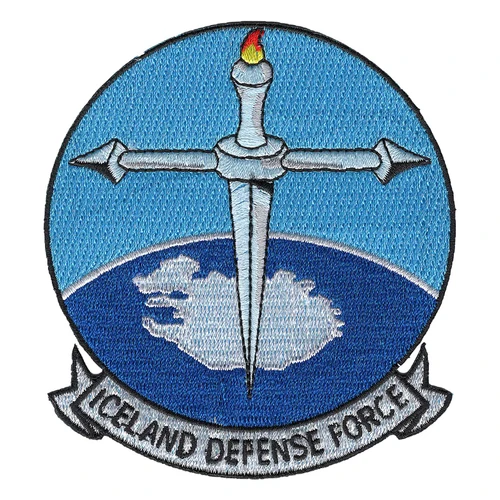
This patch is round, 3.5 inches wide by 4 inches tall, with a silver-gray scroll across the bottom carrying ICELAND DEFENSE FORCE in black block letters. The upper field is pale sky blue, and below it the curve of a dark blue globe holds a white silhouette of Iceland itself. A silver sword stands point-down over the island, its crossguard ending in spear tips and its pommel burning with a red and gold flame like a torch. The sword planted on the island says plainly what the command was there to do. It has a cut edge trimmed close to the black outline and an iron-on backing.
Duty in Iceland meant long winter dark, hard wind off the North Atlantic and a flight line that never fully stood down. That intercept count tells how busy the skies around the island stayed, decade after decade. P-3 crews logged long hours over cold water, and fighter crews launched into weather that would have grounded most squadrons. The 57th Fighter Squadron was inactivated on 1 March 1995, and rotating F-15 units carried the alert from then on. The 85th Group was inactivated on 28 June 2006, NAS Keflavik was disestablished on 8 September 2006, and the last U.S. fighters and rescue helicopters left on 30 September.
It sits well in a shadow box beside a P-3 squadron patch, a Naval Station Keflavik patch and a photo of the flight line, or on the jacket worn to a Keflavik reunion. For a son or daughter who grew up in base housing on the Reykjanes Peninsula, it is a gift that names where the family spent those winters. A small patch that covers a lot of Cold War.
Related Products


