
HC-1 Helicopter Combat Support Squadron HELSUPPRON 1 Patch
- SKU:
- 3637
- MPN:
- 3637
- Width:
- 4.25 (in)
- Height:
- 4.00 (in)
- Depth:
- 0.08 (in)
- Backing:
- Iron On
- Edging:
- Merrowed Edge
- Squadron Type:
- Helicopter Squadrons (HS / HSL / HSM / HSC / HC / HU)



Description
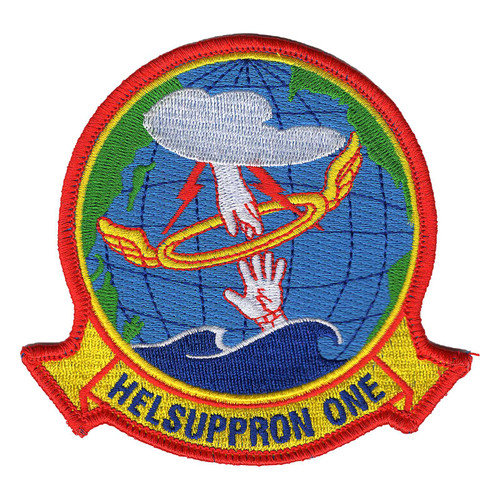
The gold ring with wings in the middle of this patch is a halo, because the sailors of HC-1 were the Pacific Fleet Angels. A hand reaches down from a cloud, through that halo, toward a second hand coming up out of the waves. That is the whole job of the squadron in one picture. HC-1 flew search and rescue and utility work for Pacific Fleet ships for 46 years. By the time the squadron was disestablished it had more than 1,680 rescues on the books.
The squadron began as Helicopter Utility Squadron One, HU-1, on 1 April 1948 at NAS Lakehurst, New Jersey, one of the first two helicopter squadrons in the Navy. It moved west to NAAS Ream Field at Imperial Beach, California, and was redesignated HC-1 on 1 July 1965. The UH-2 Seasprite, its first turbine helicopter, reached the squadron in January 1963, and later the SH-3 Sea King took over the plane guard and rescue detachments on the carriers. In July 1966 HC-1 formed the first of four gunship detachments in Vietnam, flying ex-Army UH-1B Hueys in support of river patrols in the Mekong Delta, and in 1967 those detachments became HAL-3 Seawolves. The squadron grew so large that by 1967 the Navy carved four new squadrons out of its detachments.
The patch is round with a winged banner across the bottom, finished with a red merrowed edge, 4.25 inches wide and 4 inches tall. A blue globe with dark grid lines and green continents fills the circle, the Pacific Fleet's whole area of work. Two red lightning bolts frame the hand reaching out of the white cloud. Down in the dark blue wave, the second hand reaches up, open and waiting. The yellow banner reads HELSUPPRON ONE in bold blue letters, the Navy's short title for the squadron.
HC-1 moved to NAS North Island in Coronado in 1976 and kept sending detachments to sea. The squadron flew the SH-3G Sea King and later the CH-53E. During Operation Desert Storm a detachment sailed aboard USS Tarawa LHA-1, and in 1991 HC-1 crews flew relief to civilians after the Bangladesh cyclone. The squadron was disestablished on 29 April 1994. To the aviators who went in the water and the sailors who went over the side, the Angels were the helicopter overhead.
Iron it onto a jacket or a vest, or stitch around the merrowed edge for a squadron reunion vest that sees heavy wear. It fits a shadow box with a set of aircrew wings and a photo of a Sea King on the deck. It is also a good gift for a father or grandfather who flew rescue out of Imperial Beach or North Island. A hand from the sky, a hand from the sea.
Related Products


