Flathead Biker Embroidered Patch - Orange on Black, Merrowed Border
- SKU:
- 9558
- MPN:
- 9558
- Width:
- 4.00 (in)
- Height:
- 2.00 (in)
- Depth:
- 0.08 (in)
- Backing:
- Sew On
- Edging:
- Merrowed Edge




Description
The flathead engine outlasted every expert who said it was finished. The 45-cubic-inch side-valve V-twin that Harley-Davidson built through the 1930s and 1940s became the backbone of the U.S. military's WLA fleet in World War II, and civilian riders kept running flatheads well into the 1970s because the design was honest - no rocker arms to adjust, no overhead components to fail on a long stretch of highway, nothing between the wrench and the problem that actually mattered. The word "flathead" is not a technical designation to the people who wore it. It is a credential.
The WLA shipped to Allied forces across multiple theaters during World War II, and the 45-inch flathead motor under that olive drab tank ran courier routes, recon tracks, and supply lines that kept the war moving. Stateside, the same basic architecture powered boardtrack racers, hill climbers, and the kind of Friday-night thrash sessions that built the independent shop culture. Harley produced flathead motors from 1929 through 1973, a run that covered the Depression, a World War, Korea, and the better part of the postwar American boom. Riders who came up in the 1950s and 1960s knew the flathead not as a vintage curiosity but as the motor in the shed, the one dad rode, the one that was always a few parts away from running again.
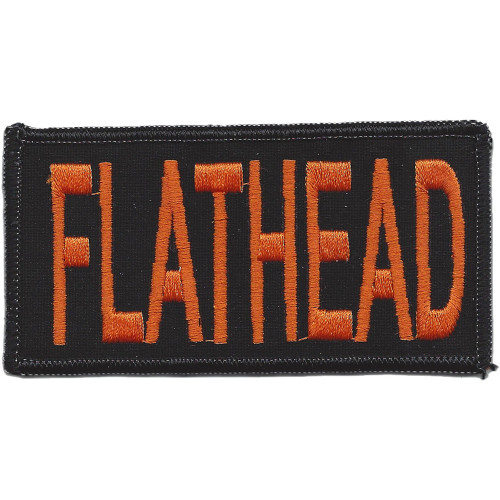
The patch is a rectangle, 4 inches wide by 2 inches tall, with a black twill field that gives the orange lettering nowhere to hide. "FLATHEAD" runs edge to edge in heavy block capitals, the stitching dense enough to read from across a room - or across a swap meet. The merrowed border locks the perimeter with an overlock stitch that keeps the edge clean whether this patch is sewn onto a riding vest, ironed onto a jacket back, or pinned flat inside a shadow box. The orange on black combination is not subtle, and it was never meant to be. Anyone who recognizes the name will recognize the attitude behind it.
There is a particular kind of respect that flathead riders have for each other that does not get extended automatically to everyone who pulls up on something newer. The flathead era produced a mechanical culture that valued problem-solving over parts-swapping, and the people who came up in it tend to have opinions about how things should be done that have not softened with age. The flathead motor is gone from production, but the community that formed around it - at swap meets, club runs, and garage nights that stretched past midnight - is very much still present. Wearing the name is a way of locating yourself in that history without having to explain it.
This patch works on a cut or vest alongside other pieces from the era, mounts cleanly in a shadow box with flathead-era memorabilia or WLA military collectibles, and makes a direct gift for the rider or wrench who has forgotten more about side-valve engines than most people will ever learn. It also travels well on a range bag or jacket for anyone who wants the reference without the full story. The patch says what it needs to say in one word.
Related Products