
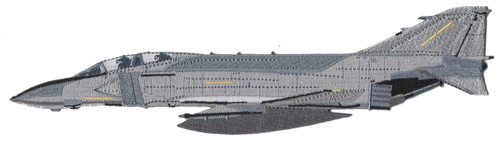
F-4 Phantom II Side View Airframe Patch
- SKU:
- 10643
- MPN:
- 10643
- Width:
- 10.00 (in)
- Height:
- 2.25 (in)
- Depth:
- 0.08 (in)
- Backing:
- Iron On
- Edging:
- Cut Edge
- Aircraft:
- F-4 Phantom II

Description
The F-4 Phantom II is the only aircraft ever flown by both the Thunderbirds and the Blue Angels. That one fact says a lot about the jet. It flew first on 27 May 1958 and went on to serve the Navy, the Marine Corps and the Air Force at the same time. McDonnell and Mitsubishi built 5,195 of them before the line closed. Anyone who crewed one, fixed one or worked a flight line beside one knows the profile on sight.
Robert C. Little flew the first one, and Navy squadrons had F-4Bs by the early 1960s, with VMFA-314 the first operational Marine squadron in 1962. The Air Force followed with the F-4C, then the F-4D and the gun-armed F-4E with its internal M61 Vulcan cannon. Over North Vietnam, Phantom crews were credited with 150.5 MiG kills. Randy Cunningham and William Driscoll became the first American aces of the war on 10 May 1972 in an F-4J, and Steve Ritchie and Charles DeBellevue made ace in Air Force F-4Ds that summer. Later came the F-4G Wild Weasel, which hunted radar sites in Desert Storm and retired on 26 March 1996.
This patch is the whole airframe in side view, a full 10 inches long and 2.25 inches tall, cut along the jet's outline. It is stitched in two-tone gray camouflage with darker panel shading and black panel lines. The tandem canopy, the long nose, the big intake, the drooped tailplane and the tall swept fin are all there. Small yellow stencil marks are stitched along the nose, the spine and the tail, and an external tank hangs underneath. There are no squadron markings, so it belongs to any Phantom outfit you served with.
The Phantom carried two crew, two J79 engines and a reputation for brute thrust over grace. Navy crews flew it off carriers until the last carrier landing on 18 October 1986. The Marines kept theirs until VMFA-112 retired the last F-4S on 18 January 1992. The Air Force flew it longest of all, finishing as QF-4 target drones, with the type retired on 21 December 2016. That is more than half a century from first flight to last, and generations of pilots, backseaters and crew chiefs in between.
It runs the length of a jacket back yoke or a flight jacket sleeve, and it fits a long shadow box under a framed photo of your jet. It is also a good gift for the dad or grandfather who still calls the back seat his office. The backing is iron-on, and a few stitches will keep it in place for good. One airframe, three services, a lot of stories.
Related Products


