
F-14 Tomcat Squadron Patch VF-2 Bounty Hunters Triangle
- SKU:
- 7119
- MPN:
- 7119
- Width:
- 4.00 (in)
- Height:
- 5.00 (in)
- Depth:
- 0.08 (in)
- Backing:
- Iron On
- Edging:
- Cut Edge
- Squadron Type:
- Fighter and Strike Fighter Squadrons (VF / VFA / VA)


Description
VF-2 and its sister squadron VF-1 took the F-14 Tomcat to sea for the first time, deploying aboard USS Enterprise CVN-65 in 1974. The Bounty Hunters were established in October 1972 at NAS Miramar to fly the Navy's new fighter. The squadron took its first F-14As in July 1973 and had its full twelve jets by spring 1974. Call sign Bullet, tail code NE in later years. For thirty years the squadron flew nothing but the Tomcat.
That first Enterprise cruise put VF-2 over Saigon in April 1975 for Operation Frequent Wind, the evacuation of Americans from South Vietnam. In September 1980 the squadron deployed aboard USS Ranger CV-61 and spent about four months in the Indian Ocean and Persian Gulf during the Iran hostage crisis. A 1984 cruise aboard USS Kitty Hawk CV-63 followed, and later Ranger cruises took the Bounty Hunters into Operation Desert Storm and Operation Restore Hope. VF-2 was the first TARPS reconnaissance squadron for Carrier Air Wing 14 and later for Carrier Air Wing 2. Around 1993 the squadron moved to USS Constellation CV-64 and the F-14D Tomcat, and after the BRAC decision that closed Miramar to the Navy it relocated to NAS Oceana.
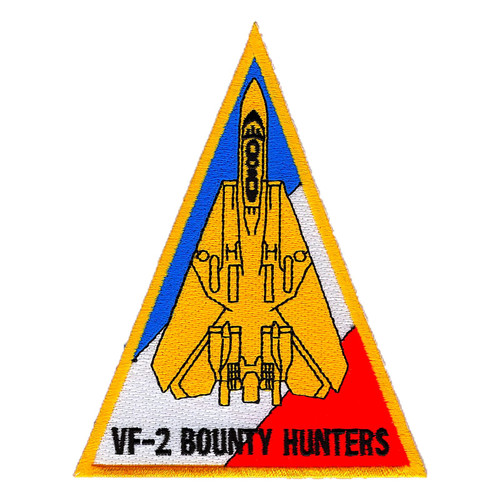
This is an upright triangle, 4 inches wide by 5 inches tall, with a gold cut edge. A gold Tomcat is stitched nose up, seen from directly above, wings swept all the way back the way the jet looked going fast. The canopy, the intakes and the twin engine nozzles are picked out in black thread. Behind it the field breaks into diagonal bands of blue, white and red, and VF-2 BOUNTY HUNTERS runs across the bottom in black block letters. Red, white, blue and yellow are the squadron's own colors, so the whole patch is in VF-2 livery. It has an iron-on backing and can also be sewn on.
The Tomcat's last combat cruise with VF-2 came in 2002 and 2003 aboard Constellation during Operation Iraqi Freedom. The squadron flew 483 sorties and dropped 294 laser-guided bombs, JDAMs and Mk 82s, and on 28 February 2003 a VF-2 Tomcat delivered the first JDAM dropped in combat by an F-14. On 1 July 2003 the squadron became Strike Fighter Squadron 2, VFA-2, and received its first F/A-18F Super Hornet that October. The Bounty Hunters fly today out of NAS Lemoore, but the men who launched in NE-coded Tomcats from Enterprise, Ranger, Kitty Hawk and Constellation carried the squadron through its fighter years.
It fits a shadow box next to a pair of wings and a Constellation cruise book, or the flight jacket worn to a VF-2 reunion. It is a good gift for a pilot, RIO or plane captain who worked Bounty Hunter Tomcats, or for anyone who still stops to watch an F-14 at an air museum. Thirty years of Tomcat flying in one small triangle.
Related Products


