F-14 Desert Storm Thief Of Baghdad Patch

- SKU:
- 6883
- MPN:
- 6883
- Width:
- 4.88 (in)
- Height:
- 4.88 (in)
- Depth:
- 0.08 (in)
- Backing:
- Iron On
- Edging:
- Merrowed Edge
- Era:
- Persian Gulf War
- Aircraft:
- F-14 Tomcat



Description
The only air-to-air kill an F-14 Tomcat scored in Desert Storm came on 6 February 1991, when a VF-1 Wolfpack crew off USS Ranger CV-61 put an AIM-9 Sidewinder into an Iraqi Mi-8 Hip helicopter. Lt. Stuart Broce flew the jet, and the squadron's skipper, Cmdr. Ron McElraft, rode in the back seat. That single kill says as much about the Tomcat's reputation as any number could. Iraqi pilots kept their distance from the big Grumman fighter and its AWG-9 radar. This patch belongs to the crews who flew it over the desert that winter.
Tomcats flew 4,124 sorties in Operation Desert Storm. VF-32 Swordsmen took F-14A Tomcats off USS John F. Kennedy CV-67 to escort the strike packages hitting targets like Al Qaim, keeping the sky clear for the bombers. On 21 January 1991 an F-14A (Plus) went down to a surface-to-air missile; Lt. Devon Jones was pulled out by a rescue helicopter, and Lt. Lawrence Slade came home after time as a prisoner of war. Squadrons such as VF-2 Bounty Hunters on the Red Sea and Persian Gulf carriers flew fighter cover, escort and reconnaissance from the opening night of 17 January to the ceasefire.
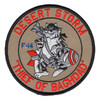
The patch is round, with a black merrowed border around a khaki twill field the color of the desert under it. DESERT STORM arches across the top in red, and "THIEF OF BAGHDAD" runs along the bottom in quotation marks, the way crews wrote a nickname. In the center a gray striped tomcat wearing a black bandana mask sits astride a bomb with red fins, a missile slung over his shoulder like a rifle. Blue F-14 lettering stands to the left. The bandit mask and the swagger tell the story without another word.
The Tomcat cat has been naval aviation's favorite mascot since the airplane came to the fleet, and crews gave him a new costume for every cruise. Desert Storm gave him a bandit's mask and a bomb to ride. Behind the cartoon were long nights on the catapult, plane captains and ordnancemen working in heat that never let up, and RIOs watching scopes for a fight the Iraqis would not offer. The men who flew and fixed Tomcats in 1991 remember it as the jet's war.
Put it in a shadow box beside a cruise book, your squadron patch and an F-14 Tomcat Operation Desert Storm patch, or wear it on a flight jacket to a Tomcat reunion. It makes a fine gift for the plane captain, maintainer or aircrew dad who still calls it the Turkey. The patch measures 4.88 by 4.88 inches with an iron-on backing and a merrowed edge, and sews on just as well. The Tomcat is gone from the fleet, but not from the men who kept it flying.
Related Products