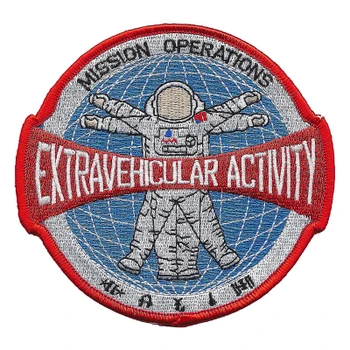
EVA Extravehicular Activity Vitruvian Spaceman 3 Star Patch
- SKU:
- 8829
- MPN:
- 8829
- Width:
- 4.00 (in)
- Height:
- 4.00 (in)
- Depth:
- 0.08 (in)
- Backing:
- Sew On
- Edging:
- Merrowed Edge


Description
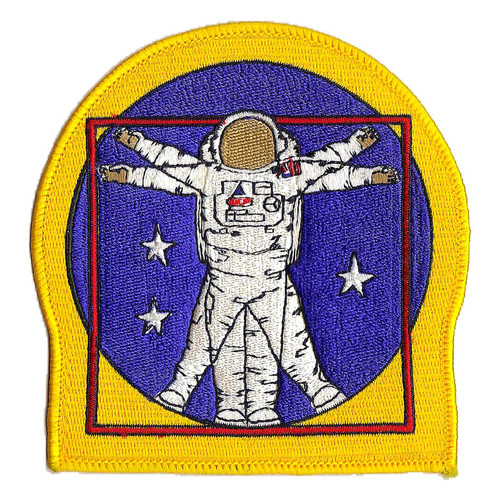
The three stars on this patch stand for the three American programs that first sent people outside a spacecraft: Gemini, Apollo and Skylab. The spacesuited figure stands inside a circle and a square with extra arms and legs, the same pose Leonardo da Vinci drew for his Vitruvian Man around 1490. Spacewalkers call him the Vitruvian Spaceman. The design came out of Hamilton Standard, the company that built the shuttle spacesuits, where it was worked up by Fred Keune, manager of its Houston office, and Walter J. Wick, its medical director, around the theme of extending the dimensions of man. Later versions added two more stars, one for the space shuttle and one for the International Space Station.
Each star has a first behind it. Ed White left Gemini IV on June 3, 1965, and spent more than 20 minutes outside, the first American spacewalk. On July 20, 1969, Neil Armstrong and Buzz Aldrin walked on the Moon during Apollo 11, the start of the lunar surface EVAs that ran through Apollo 17. On June 7, 1973, Skylab 2 astronauts Pete Conrad and Joe Kerwin went outside the damaged station and freed its jammed solar array wing, saving the Skylab program. The shuttle era brought its own first on April 7, 1983, when Story Musgrave and Don Peterson made the first shuttle spacewalk on STS-6.
The patch is about 4 inches wide and 4 inches tall, shaped like a rounded arch with a flat base and a rolled yellow merrowed border. Inside the gold field a royal blue disc and a thin red square frame the figure, just as the circle and square frame da Vinci's drawing. The white suit is stitched with black outlines, a gold visor, a small US flag on the upper arm and the control box on the chest. Two sets of arms and legs show the figure in both positions at once. Three white stars float on the blue, two on the left and one on the right. It has a sew-on backing.
An EVA is one of the most demanding jobs in human spaceflight. Hours of work in a pressurized suit wear out hands and shoulders, and every move is rehearsed underwater for weeks before it is tried in orbit. The suit engineers, trainers, flight controllers and astronauts who made those walks possible are a small community, and they know this figure on sight. The three-star version goes back to the years when every spacewalk was still close to a first. It honors the people who went outside and the people on the ground who got them back in.
It works in a shadow box beside a space shuttle mission patch, or on a flight jacket or backpack for a trip to Johnson Space Center or Kennedy Space Center. It also makes a fitting gift for a student headed into engineering or anyone who grew up watching astronauts work outside the shuttle. Three stars and one spacesuit sum up the first decade of American spacewalking.
Related Products