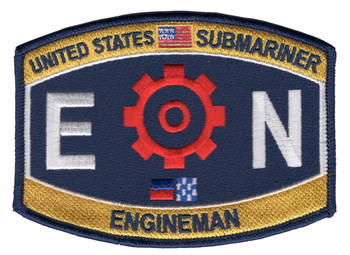
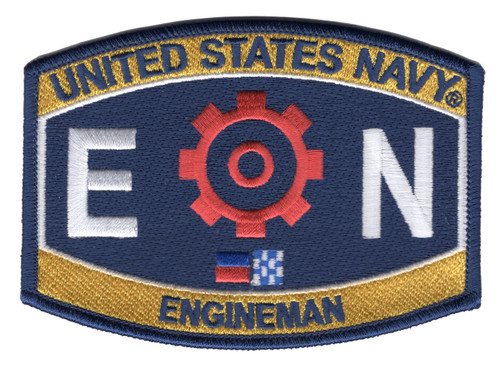
EN Engineman Rating Patch Navy Naval Insignia
- SKU:
- 477
- MPN:
- 477
- Width:
- 4.50 (in)
- Height:
- 3.25 (in)
- Depth:
- 0.08 (in)
- Backing:
- Iron On
- Edging:
- Merrowed Edge

Description
The Engineman rating of the United States Navy represents the elemental force that keeps ships moving when the sea offers no forgiveness. Long before electronics dominated the fleet, Enginemen were already deep in the machinery spaces, surrounded by heat, noise, vibration, and responsibility. The EN rating is rooted in the simple truth that naval power begins with propulsion, and propulsion depends on those who understand engines not as equipment, but as living systems that must be respected and mastered.
The Engineman rating emerged as the Navy transitioned from sail to steam and later to internal combustion power. As destroyers, patrol craft, auxiliaries, and landing ships expanded across the fleet, the Navy required specialists capable of operating, maintaining, and repairing diesel engines under all conditions. Enginemen became indispensable aboard surface ships where reliability meant the difference between mission success and vulnerability at sea.
World War II defined the Engineman’s legacy at scale. EN sailors served aboard destroyers escorting Atlantic convoys, landing ships supporting amphibious assaults, patrol craft hunting submarines, and auxiliary vessels sustaining fleet operations across the Pacific. In engine rooms that never cooled and rarely slept, Enginemen kept shafts turning through battle damage, extended operations, and emergency conditions where failure was not an option.
During the Cold War, the Engineman rating continued to evolve as the Navy expanded its global presence. Diesel-powered ships supported forward deployments, coastal patrols, and logistics missions that demanded endurance and mechanical precision. From the Mediterranean to Southeast Asia, Enginemen stood watch during periods of heightened tension, ensuring ships could respond immediately when called upon.
Vietnam-era naval operations further reinforced the EN identity. Riverine craft, patrol boats, amphibious vessels, and support ships relied on Enginemen to maintain engines under extreme heat, humidity, and operational tempo. In these environments, improvisation and experience mattered as much as formal training. The rating became associated with self-reliance, mechanical instinct, and calm under pressure.
The culture of the Engineman rating is forged below decks, away from the bridge and the spotlight. EN sailors are known for their practicality, resilience, and deep respect for machinery. They understand that propulsion casualties do not announce themselves politely—they appear suddenly, often at the worst moment. The crossed piston insignia symbolizes controlled power, technical competence, and the unseen labor that allows the fleet to maneuver, deploy, and return home.
Within the United States Navy, the Engineman rating carries a quiet pride. It reflects a career built on grease-stained coveralls, long watches, and responsibility that cannot be deferred. Ships may change, technologies may advance, but the need for skilled Enginemen remains constant wherever diesel power drives naval operations.
Related Products