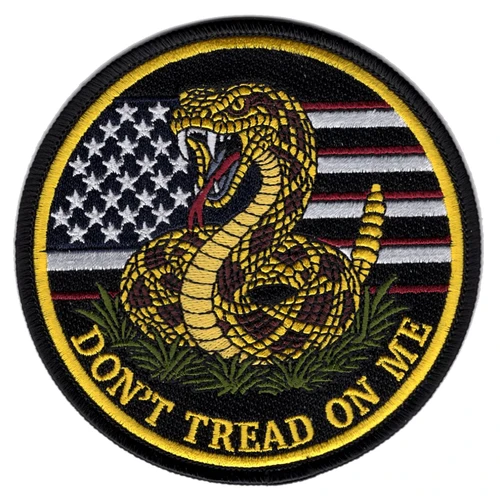
Don't Tread On Me American Flag Rattlesnake Patch
- SKU:
- 100443
- Width:
- 4.00 (in)
- Height:
- 4.00 (in)
- Depth:
- 0.02 (in)
- Backing:
- Hook & Loop
- Edging:
- Merrowed Edge



Description
The first United States Marines enlisted at Philadelphia in the fall of 1775, and they marched behind drums painted yellow, every drumhead carrying a coiled rattlesnake with thirteen rattles. The snake was already familiar by then. Benjamin Franklin had cut one into a newspaper woodcut in 1754, chopped into segments under the words Join, or Die, and twenty years later every colonist understood what a rattlesnake on a yellow field was saying. It meant the thirteen were finished asking. This patch carries that same coiled snake, in the same posture, set over the flag those Marines were about to spend eight years earning.
Christopher Gadsden of South Carolina sat on the Marine Committee, the seven men outfitting the Continental Navy for its first mission, and in December 1775 he handed a yellow rattlesnake flag to Commodore Esek Hopkins. It went up the main mast of USS Alfred on December 20 as Hopkins's personal standard. The flag most sailors know is its cousin, the First Navy Jack, thirteen red and white stripes with the snake stretched along them rather than coiled, and DONT TREAD ON ME across the lowest white stripe. Hopkins ordered his ships to fly that one a month later. The Navy brought it back on September 11, 2002 and flew it from every commissioned vessel until June 4, 2019, which means a whole generation of sailors went to sea under a rattlesnake and can tell you exactly which one they served under.
The patch is round, four inches across, bordered in black merrowed stitch rolled thick enough to feel under your thumb, with a gold ring set just inside it. The flag behind the snake is blacked out, navy canton and white stars, the stripes in white and dark red laid over black. The rattlesnake is coiled dead center in gold and deep maroon, jaw open, fangs down, tongue forked, rattle standing straight up on the right where you cannot miss it. Green grass runs along the bottom under the coil. DON'T TREAD ON ME arches across the lower edge in gold thread, apostrophe and all, which the old jack never bothered with.
The rattlesnake was a deliberate choice, and a local one. There are none in Europe. The colonies picked an animal the mother country did not have and could not mistake, then put it on drums, on jacks, and on the personal standard of the first man to command an American fleet. The Corps was newly raised when its drummers carried it through Philadelphia. The Navy flew its striped cousin from every commissioned ship for seventeen years within living memory, so this is not a symbol anyone has to reach back very far to have stood under.
This one lives on gear more than in a frame. The backing is hook and loop, so it lands on a plate carrier, a range bag or any loop panel and comes off just as fast when you want it somewhere else, and it takes a needle fine if you would rather it stayed on a vest for good. Others end up in a shadow box next to a Revolutionary print. Four inches of gold thread and an animal that has been making the same point since 1775.
Related Products