
DESRON 2 Destroyer Squadron Two Patch
- SKU:
- 32
- MPN:
- 32
- Width:
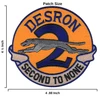
- 4.88 (in)
- Height:
- 4.50 (in)
- Depth:
- 0.08 (in)
- Backing:
- Iron On
- Edging:
- Cut Edge


Description
Destroyer Squadron Two was formed in May 1919, and the Navy counts it as the longest-serving destroyer squadron in its history. Its first flagship was the cruiser USS Columbia, and its first home was the Atlantic Fleet. More than a century later the squadron still goes to sea, now with Arleigh Burke-class guided missile destroyers. The motto is Second to None, a fair claim for a squadron with the number 2 on its colors. Its ships have taken part in almost every major Navy combat operation since World War II.
In 1937 DESRON 2 destroyers joined the search for Amelia Earhart. The squadron went to Pacific waters in December 1941 and screened the carrier USS Yorktown through the early raids, the Battle of the Coral Sea and the Battle of Midway. It lost Sims at Coral Sea, Hammann at Midway, and O'Brien and Walke in the Guadalcanal campaign, and its ships fought on through the Aleutians, the Gilberts and Marshalls, the Marianas, the Philippines and Okinawa. In Korea from 1950 to 1952 they screened Task Force 77 carriers striking the Yalu River power plants and worked with Task Force 95. Squadron ships recovered Scott Carpenter's Aurora 7 Mercury capsule in 1962, stood the Cuban quarantine that same year, and fired gunfire support and Operation Sea Dragon missions off Vietnam in 1968. In 2003 the commodore was Sea Combat Commander during Operation Iraqi Freedom.
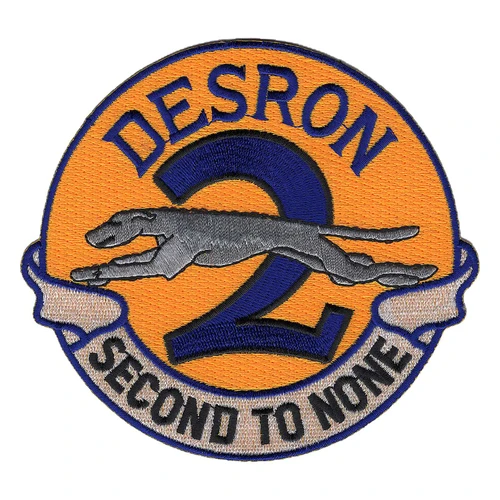
This patch is round, with an orange-gold field inside a navy blue border and a cut edge that follows the shape, 4.88 inches wide and 4.5 inches tall. DESRON arches across the top in navy blue letters over a large numeral 2. A gray greyhound in full stride runs straight across the 2, and greyhound is an old Navy nickname for a destroyer. A pale scroll wraps the bottom and carries the motto, SECOND TO NONE, in black. It has an iron-on backing and can also be sewn down for good.
The record behind those colors is long, and it was paid for. Wikipedia credits the squadron's ships with 145 battle stars in World War II, and more than 450 of its sailors were killed in that war. Tin can sailors from DESRON 2 rode out kamikaze attacks off Okinawa and screened carriers through every kind of weather. In 1989 the squadron's Charleston ships helped after Hurricane Hugo and earned the Humanitarian Service Medal. Today it sails with Carrier Strike Group 12 out of Norfolk with ships such as USS Stout, USS McFaul, USS Oscar Austin, USS Bulkeley and USS Mason. Every crew that has served under the greyhound has added to the same record.
It fits in a shadow box beside a ship's plaque and a photo from a destroyer's bridge wing, or on the jacket worn to a Tin Can Sailors reunion. It also makes a good gift for a shipmate who served in a DESRON 2 destroyer, or a son who wants to know what his father's squadron did. Second to None, since 1919.
Related Products


