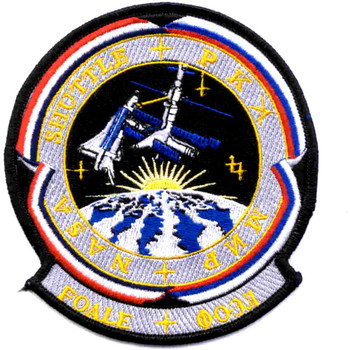
Dawn Mission to Vesta and Ceres NASA Discovery Program Patch

- SKU:
- 9890
- MPN:
- 9890
- Width:
- 4.00 (in)
- Height:
- 4.00 (in)
- Depth:
- 0.08 (in)
- Backing:
- Iron On
- Edging:
- Cut Edge


Description
Dawn was the first spacecraft to orbit two different worlds beyond Earth, the giant asteroid Vesta and the dwarf planet Ceres. It got there on xenon ion engines, pushing gently for months at a time across the main asteroid belt between Mars and Jupiter. At Vesta in 2011 it became the first spacecraft to orbit a body in that region. At Ceres in 2015 it became the first mission to visit a dwarf planet. This patch puts both destinations, the spacecraft and the whole partner team on one round badge.
NASA selected Dawn for its Discovery Program in December 2001, with Christopher Russell of UCLA leading the science team and the Jet Propulsion Laboratory managing the mission. It launched on September 27, 2007, on a Delta II 7925H from Space Launch Complex 17B at Cape Canaveral. Three xenon ion thrusters, derived from the NSTAR engine tested on Deep Space 1, did the work, one at a time. Dawn reached Vesta on July 16, 2011, left on September 5, 2012, and entered orbit around Ceres on March 6, 2015, where it photographed the bright regions of Occator Crater and the lone mountain Ahuna Mons. The mission ended on November 1, 2018, when the spacecraft ran out of the hydrazine it used to keep its antenna pointed at Earth. By then its odometer read about 4.3 billion miles.
This is a 4 inch round patch with a wide gold border and a cut edge. NASA DISCOVERY MISSION runs across the top in black, and the rest of the ring names the team: UCLA, JPL, Orbital, DLR, MPS, ASI, INAF and LANL. Orbital Sciences built the spacecraft, the German Aerospace Center (DLR) and the Max Planck Institute for Solar System Research (MPS) supplied the framing cameras, the Italian Space Agency (ASI) and INAF the visible and infrared spectrometer, and Los Alamos National Laboratory the gamma ray and neutron detector. Inside, Dawn crosses a mottled blue sky on two long blue solar wings, with a white trail streaming behind it. Vesta sits small at the upper left and Ceres larger at the lower right, each labeled in white, and Dawn is spelled out in light blue along the bottom. It has an iron-on backing, and a few stitches will hold it for good.
Dawn showed that Vesta and Ceres, neighbors in the same belt, grew up very differently. Its data pointed to dwarf planets that may have held oceans for much of their history and possibly still do. Mission director Marc Rayman said at the end that it was hard to say goodbye, but it was time. The spacecraft is still circling Ceres, and engineers expect it to stay in orbit for at least 20 years. For the teams at UCLA, JPL and the partner labs, that silent orbit is the last stop of an 11-year trip.
It fits a shadow box next to Deep Space 1 and other Discovery Program patches, or the backpack of a student who wants to work on the next one. It also makes a good gift for an engineer or scientist who worked on Dawn or followed it from launch to Ceres. Mount it beside a print of the Occator bright spots and it needs no caption. Two worlds, one spacecraft and a long, quiet push across the asteroid belt.
Related Products