USS Ticonderoga CVA-14 Essex Class Attack Carrier Patch

- SKU:
- 1397
- MPN:
- 1397
- Width:
- 4.75 (in)
- Height:
- 5.00 (in)
- Depth:
- 0.08 (in)
- Backing:
- Iron On
- Edging:
- Cut Edge


Description
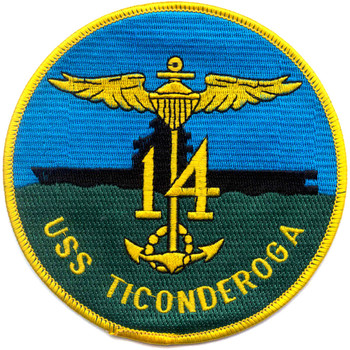
The hull number on this patch is spelled out around the flight deck itself: a C on the left, an A on the right, and a V and a 14 on the deck between them. Ticonderoga carried that A for attack from 1 October 1952, when she was reclassified CVA-14, until 21 October 1969, when she was redesignated the antisubmarine carrier CVS-14. She was laid down at Newport News Shipbuilding as Hancock on 1 February 1943 and renamed Ticonderoga that May. She was commissioned on 8 May 1944, one of the long-hull Essex-class carriers built with a longer bow for antiaircraft guns. The CVA years, 1952 through 1969, are the years this patch belongs to.
In World War II she earned five battle stars in the Pacific, and on 21 January 1945 two kamikazes hit her, one through the flight deck and one near the island, wounding Captain Dixie Kiefer among many others. After the SCB-27C conversion she recommissioned on 11 September 1954 with steam catapults, and SCB-125 work in 1956 and 1957 gave her an angled deck and an enclosed hurricane bow. On 2 August 1964 her F-8E Crusaders went to the aid of the destroyer USS Maddox in the Gulf of Tonkin, and on 5 August she and USS Constellation flew 60 sorties against four PT-boat bases. Her A-4 Skyhawks and F-8 Crusaders flew in Operation Rolling Thunder on the 1966 to 1967 cruise with Carrier Air Wing 19 (CVW-19) aboard, and in 1968 she was converted to handle the A-7 Corsair II. On 9 July 1968 LCDR John B. Nichols claimed her first MiG kill.
The patch is a shield shape, 4.75 inches wide by 5 inches tall, with a cut edge that follows its black outline. A blue scroll across the top reads ATTACK READY, and USS TICONDEROGA arches over the ship in heavy black letters. The carrier is drawn bow-on from above, a gray flight deck with the island and mast to one side, a pair of gold wings spread at the head of the deck, and the V and 14 stitched in black on the gray. At the bow a red-rimmed mouth with white fangs opens over blue water, and white bow waves curl out to either side. Gold drapes and a twisted white rope frame both edges, with the C and the A standing in black on the white field.
Her record reads like a history of carrier aviation in one hull: five battle stars from the Pacific war, 12 from Vietnam, three Navy Unit Commendations and a Meritorious Unit Commendation. The first two of those Navy Unit Commendations came for the Tonkin Gulf in 1964 and for the Rolling Thunder cruise. As CVS-14 she recovered the Apollo 16 crew in April 1972, the Apollo 17 crew near American Samoa that December, and the Skylab 2 astronauts near San Diego on 22 June 1973. She was decommissioned on 1 September 1973 and struck from the Navy list that November. For the sailors and air wing men of the CVA years, she is the carrier that was on station when the Tonkin Gulf put Vietnam on the front page.
Mount it in a shadow box beside a cruise book and a CVW-19 patch, or sew it on the vest you wear to a ship's reunion. It also makes a fine gift for a son or grandson who grew up hearing about catapult shots and night recoveries off Vietnam. It measures 4.75 by 5 inches with a cut edge and an iron-on backing, and it can also be sewn on. Anyone who worked that flight deck before she became the CVS-14 USS Ticonderoga that recovered Apollo 17 will recognize it across a room.
Related Products