
CV-63 USS Kitty Hawk Aircraft Carrier Patch

- SKU:
- 8108
- MPN:
- 8108
- Width:
- 5.00 (in)
- Height:
- 3.62 (in)
- Depth:
- 0.08 (in)
- Backing:
- Iron On
- Edging:
- Cut Edge



Description
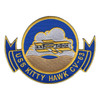
The biplane in the middle of this patch is the Wright Flyer, because the ship carried the name of the North Carolina town where Orville and Wilbur Wright made the first powered flight in 1903. Kitty Hawk was the second Navy ship to bear that name and the lead ship of her class. Sailors called her the Battle Cat. New York Shipbuilding laid her keel at Camden, New Jersey, on December 27, 1956, and she was commissioned at the Philadelphia Naval Shipyard on April 29, 1961, with Captain William F. Bringle in command. She stayed in commission for 48 years.
San Diego was her home port for about 25 years. She made repeated Southeast Asia deployments, late 1965 into 1966, November 1966 to May 1968 and November 1968 to June 1969, and earned a Presidential Unit Citation for the 1967 and 1968 line period that took in the Tet Offensive. Carrier Air Wing 15 (CVW-15) made her deployments of the early 1990s, and Carrier Air Wing 11 (CVW-11) sailed with her in 1996. In 1998 she moved to Yokosuka, Japan, as the Navy's forward deployed carrier, with Carrier Air Wing 5 (CVW-5). In October 2001 she sailed to the North Arabian Sea with a reduced air wing as a floating staging base for the 160th Special Operations Aviation Regiment, and in 2003 she spent 110 straight days at sea supporting Operation Southern Watch and Operation Iraqi Freedom.
The patch is 5 inches wide by 3.62 inches tall, cut close to the outline of its shape. A gold edged blue circle sits on a blue ribbon that sweeps out to two notched tails, and USS KITTY HAWK CV-63 runs along the ribbon in gold letters. Inside the circle, the gold and white Flyer crosses a bank of silver clouds above a tan sand hill, the kind of ground the Wrights flew over on the Outer Banks. Gold, royal blue and silver keep it simple and easy to read from across a room. The backing is iron-on, and it can be sewn on as well.
Kitty Hawk was the last conventionally powered carrier in the active fleet. When she handed the Yokosuka job to USS George Washington in 2008, she sailed home to be decommissioned, with the ceremony held on January 31, 2009, and the decommissioning made official on May 12, 2009. She was towed around South America to Brownsville, Texas, in 2022 and broken up there. Generations of airedales, snipes, deck apes and air wing squadrons wore her name over four decades, from the Gulf of Tonkin to the Persian Gulf. For most of them, the Battle Cat is simply the ship.
Put it in a shadow box beside a cruise book and your CVW-15, CVW-11 or CVW-5 squadron patches, or on the vest you wear to a Kitty Hawk reunion. It is also a good gift for a shipmate who rode her out of San Diego or Yokosuka. The Flyer that started it all, on the ship that carried the name.
2 Reviews
-
Super craftsmanship on this authentic Kitty Hawk patch
So impressed with your attention to detail this patch can be ironed on or sewed on bravo Zulu guys
-
Purchase of some pâtches
The product is excellent, your service is outstanding. You are all adorable. I was happy to be your client. Best regards
Related Products


