
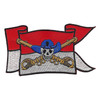
Cavalry Guidon With Skull and Crossed Sabers Patch

- SKU:
- 9404
- MPN:
- 9404
- Width:
- 4.50 (in)
- Height:
- 2.50 (in)
- Depth:
- 0.08 (in)
- Backing:
- Iron On
- Edging:
- Cut Edge



Description
Red over white has meant cavalry since 1834, when regulations first gave dragoon companies a red-over-white swallowtail guidon. The Civil War traded it for stars and stripes, and General Order 10 brought the red and white back in 1885, with the regimental number on the red half and the troop letter on the white. This patch flies that guidon without a number or a letter, so it belongs to every troop at once. In the middle sits a grinning skull in a blue cavalry Stetson, with a pair of crossed sabers behind it. Crossed sabers are the cavalry's mark, and anyone who rode with a troop, on horseback, in a Bradley or in a Kiowa, knows the flag on sight.
The 1834 guidon was silk, 27 by 41 inches, with a 15-inch swallowtail, "U.S." in white on the red half and the company letter in red on the white. General Order 4 of 1862 put stars and stripes on cavalry guidons, with the stars in two circles in the canton, and gold-painted stars later replaced silver ones that tarnished in the field. From 1863 a company that had borne a meritorious part in a battle could paint the battle's name on its guidon. In 1895 a bunting guidon came in for everyday use, with silk saved for campaign and parade, and Army Regulation 129 abolished silk guidons in 1922. AR 260-10 cut the guidon to 20 by 27 3/4 inches with a 10-inch swallowtail in 1931, and in 1944 it put the battalion or squadron number in the hoist.
The patch is cut edge, trimmed to the outline of the flag itself, with a black border stitch following every fold. It measures 4.5 inches wide by 2.5 inches tall and has an iron-on backing, and it can be sewn on as well. The guidon is shown in motion, curling at the hoist and snapping out to a full swallowtail at the fly, red over white the way it has looked since 1885. The skull is stitched in white with black eye sockets and a full row of teeth, wearing a broad-brimmed blue Stetson with a black crease. The crossed sabers run behind it, their blades reaching to the top corners of the flag and their gold guards and grips crossing below the jaw.
The guidon is the troop's flag, carried at the front of a formation and cased when the unit moves out. The skull and the Stetson are morale art rather than regulation, the kind of trooper humor that turns up on squadron coins, troop T-shirts and the walls of a motor pool office. Put together with the red and white and the sabers, they make a patch about the troopers rather than any one unit. Cavalry scouts, tankers, aviators and the old horse soldiers all fit under it. That is why it gets worn by men who served decades apart.
It fits a jacket, a vest worn to a squadron reunion, or a range bag, and it holds its own in a shadow box with a set of spurs or a troop photograph. Give one to a cavalry veteran, or to a young trooper headed to his first squadron. Red over white still says the same thing it said in 1834.
Related Products


